Implantology – a new smile and a lasting solution for missing teeth
Dental implantology focuses on restoring missing teeth using implants, which are fixtures placed in the jawbone or mandible. It is a solution for people who have lost one tooth, several teeth, or their entire dentition, for example as a result of tooth decay, gum disease, or an injury.
Implantology – what is it and when is it worth considering?
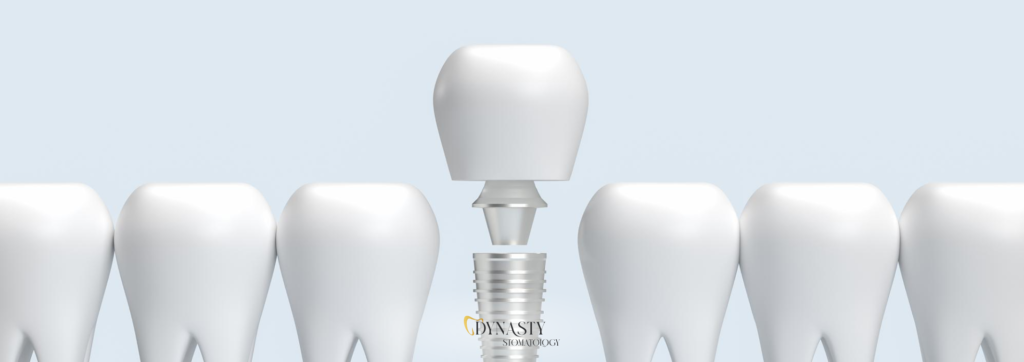
Implantology makes it possible to restore a missing tooth in a way that closely resembles the natural structure of a tooth. The implant replaces the root, while the dental crown restores the visible part of the tooth, its shape, and its function when biting and speaking.
Treatment may be considered for single gaps, extensive tooth loss, and complete tooth loss. Eligibility always requires a consultation, an oral examination, and an assessment of bone conditions. At Dynasty Stomatology, we plan treatment individually, discussing the stages, possible alternatives, and costs.
What does a dental implant consist of?
A complete implant-supported restoration consists of several elements. The implant itself is a small, usually titanium fixture placed in the bone. It is not visible once treatment has been completed.
An abutment is attached to the implant, and a dental crown is placed on top of it. The crown is the part that the patient sees in their smile and uses while eating.
Implant, abutment, and crown – the key differences
The implant replaces the root of the lost tooth and provides a stable foundation for the restoration. The abutment connects the implant fixture to the crown, while the crown recreates the visible part of the tooth.
This is why people commonly say that an implant replaces an entire tooth, although medically, the implant fixture itself replaces the root. Only the implant, abutment, and crown together form a complete restoration.
Why are implants made of titanium?
Titanium is used in implantology because it can integrate with the bone through a process called osseointegration. Healing and stabilisation of the implant usually take from several weeks to several months.
The exact time depends, among other factors, on bone quality, the implant placement site, the patient’s health, and the extent of treatment. The dentist assesses the healing progress during follow-up visits.
Implantology at Dynasty Stomatology – who is treatment intended for?
Dental implant treatment at Dynasty Stomatology is intended for patients with single, multiple, or complete tooth loss. It may form part of a broader treatment plan involving surgery, bone regeneration, periodontal treatment, and prosthetic dentistry.
The dentist decides whether implant placement is possible after diagnostic testing and an analysis of the patient’s health. Not every missing tooth requires the same restoration method.
Missing one or several teeth
When a single tooth is missing, an implant can make it possible to place a crown without relying on neighbouring teeth for support. For larger gaps, implants can serve as supports for a dental bridge.
Such treatment may improve chewing comfort, speech clarity, and the appearance of the smile. However, the choice of solution depends on oral conditions and the patient’s expectations.
Restoring a full set of teeth with implants
In cases of complete tooth loss, it is possible to restore an entire dental arch with implants. In certain cases, a full set of teeth can be supported by 4 implants in the upper jaw and 4 implants in the lower jaw.
This is not an automatic approach for every patient. The number of implants, the type of prosthetic restoration, and the potential need for bone regeneration are determined by diagnostics and the dentist’s treatment plan.
What does dental implant treatment involve?
Dental implant treatment is a process rather than a single appointment. It includes a consultation, diagnostics, preparation for the procedure, implant placement, a healing period, crown placement, and subsequent follow-up visits.
A typical course of treatment is as follows:
- Consultation and imaging tests.
- An individual treatment plan and discussion of costs.
- Possible preparation of the mouth or bone.
- Implant placement procedure.
- Healing and integration of the implant with the bone.
- Placement of the abutment and crown.
- Follow-up visits and professional hygiene appointments.
Consultation and diagnostics with a 3D CT scanner
At Dynasty Stomatology, diagnostics before implant placement may include a 3D CT scan. A three-dimensional image helps the dentist assess the teeth, bone quantity and condition, and plan the implant position.
The examination makes it possible to prepare treatment based on the patient’s individual anatomy. During the appointment, we also discuss expectations, potential risks, and alternatives.
Treatment planning and preparation for the procedure
Before treatment begins, the dentist analyses the patient’s health, medications, chronic conditions, and the condition of the gums and teeth. If necessary, they may recommend prior restorative treatment, periodontal treatment, or a procedure to prepare the bone.
It is worth bringing a list of medications and information about previous treatment to the consultation. The patient receives an individual plan along with an estimated cost range.
Implant placement and the healing period
Implant placement is a surgical procedure usually performed under local anaesthesia. Placing one implant may take around 30 minutes and generally does not require hospitalisation.
After the procedure, the patient receives recommendations regarding oral hygiene, diet, and follow-up visits. Anaesthesia limits pain sensations during the procedure, but post-treatment reactions and the need for pain medication vary from person to person.
Benefits of implants and comparison with a bridge or denture
Implants are permanently placed in the bone and do not need to be removed for daily cleaning. They can support the restoration of chewing function and smile aesthetics if the patient maintains proper hygiene and attends follow-up appointments.
Dental bridges and removable dentures are also valuable treatment options. The choice depends on clinical conditions, budget, treatment time, and the patient’s preferences.
Is an implant better than a bridge?
Not always. An implant may make it possible to avoid preparing adjacent teeth, which serve as supporting teeth in a conventional bridge. On the other hand, implant placement requires sufficient bone volume, surgical treatment, and time for healing.
A bridge can be a beneficial option in other situations, for example when neighbouring teeth already require restoration. The dentist will compare the aesthetics, hygiene, costs, and predictability of both options.
Contraindications and safety of implant placement
The safety of implant placement begins with a thorough eligibility assessment. The dentist evaluates the condition of the mouth, bone quantity, hygiene, overall health, and the ability to attend regular follow-up visits after treatment.
Some issues require only postponing the procedure and receiving treatment first, such as active inflammation in the mouth. In other cases, the dentist may suggest an alternative restoration method.
Which conditions and habits should be discussed with an implantologist?
You should report chronic conditions, all medications you take, smoking, gum problems, previous procedures, and difficulties with healing. This information helps the dentist plan treatment safely.
You should not assume on your own that a particular condition rules out an implant. The decision belongs to the treating dentist after an examination and review of the documentation.
Why is it not worth delaying after losing a tooth?
After tooth loss, the bone at the site of the missing tooth may gradually deteriorate. For this reason, it is worth attending a consultation soon after an extraction to discuss options for preserving bone and planning a future restoration.
In selected cases, an implant can be placed directly after tooth removal. However, immediate implant placement is not suitable for everyone and requires qualification by a dentist.
How much does a dental implant cost and what does the price include?
The price of dental implant treatment does not refer solely to the cost of the implant fixture itself. The total budget is affected by diagnostics, the number of implants, any bone regeneration, the implant system, the abutment, crown, follow-up visits, and professional hygiene appointments.
Implants are private treatment, and the scope of any publicly funded services should always be confirmed individually with the National Health Fund. At Dynasty Stomatology, we provide an exact quote after the consultation and diagnostic assessment.
| Treatment plan element |
Why it affects the cost |
| 3D diagnostics |
Makes it possible to assess the bone and plan the procedure |
| Implant |
Type and system of the implant fixture |
| Abutment and crown |
Material and method used to create the restoration |
| Preparatory procedures |
For example, bone regeneration or sinus lift surgery |
| Follow-up visits and professional hygiene |
Help monitor the condition of the implant and surrounding tissues |
What should a treatment plan include?
It is worth asking whether the plan includes the consultation, imaging tests, implant, abutment, crown, possible bone regeneration, follow-up visits, and professional hygiene. Comparing offers solely based on the price of the implant fixture may not show the full cost of treatment.
At the clinic, you can also discuss available instalment payment options, including MediPay, MediRaty, and an internal instalment plan, if these are available for the treatment concerned.
Warranty and implant system
Warranty terms should always be checked for the specific system and individual treatment plan. Warranties may apply to different elements and may require regular follow-up visits and proper hygiene.
You should not base your decision solely on general manufacturer declarations. We discuss the details of the terms for the selected solution during the consultation.
Oral hygiene after implant placement
Implants require daily brushing, cleaning between the teeth, and regular professional hygiene appointments. A crown on an implant cannot develop decay, but the surrounding gums and bone still require protection.
At Dynasty Stomatology, dental hygienists show patients how to brush and floss implant-supported teeth. We tailor recommendations to the type of restoration, access to the spaces between teeth, and the condition of the gums.
How can you schedule an implant consultation at Dynasty Stomatology?
The first step is an implant consultation at Dynasty Stomatology. It is worth providing information about missing teeth, previous treatment, medications taken, and expectations regarding the restoration.
During the appointment, the dentist will assess treatment options, perform or order the necessary diagnostics, and prepare an individual plan. Dynasty Stomatology sees patients at Romanowicza Street 1/LU3 and Romanowicza Street 4B in Krakow. You can contact us by phone at +48 123 002 806.