



After tooth damage, many people face a number of unpleasant problems and urgent challenges. First, constant discomfort and painful sensations appear in the oral cavity. Second, it becomes difficult to bite and thoroughly chew solid food. Third, your psychological well-being may suffer, as your smile loses its aesthetic appeal.


Resistance and strength

Aesthetic and long-lasting effect

Reliable durability
When is dental microprosthetics recommended?
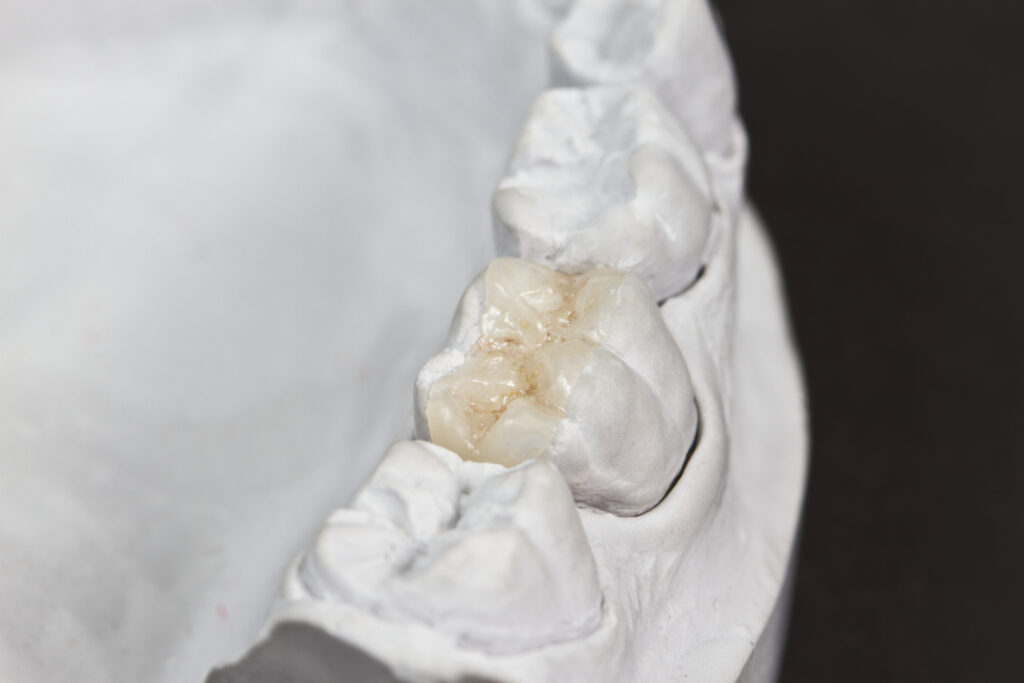
Your dentist may recommend tooth micro-prosthetics if you have partial tooth destruction caused by mechanical trauma or advanced caries. This method is particularly suitable when more than one-third of the tooth tissue has been lost.
Ceramic inlays allow you to eliminate common tooth defects such as:
- Chips and cracks on the tooth crown;
- Tooth tissue erosion;
- Tooth wear;
- Deep carious lesions;
- Enamel discoloration;
- Noticeable gaps between teeth.
This modern dental treatment offers an effective, durable, and aesthetic restoration option for preserving your smile and maintaining healthy teeth.
Price: Micro-Prosthetics in Krakow
-
Prosthodontic consultation
250 PLN -
Tomography of 1 jaw
250 PLN -
Tomography of 2 jaws
350 PLN
How the Dynasty Stomatology dental clinic's loyalty program works
Learn more about the loyalty program
Step 01
Visit the clinic and scan the QR code at the reception desk
Step 02
Register online — enter your details
Step 03
Receive and accumulate points after each visit
Do you want to effectively and quickly improve the quality of your life?
Make an appointment!
By clicking the button, you agree to the processing of personal data in accordance with the privacy policy.
Frequently asked questions about dental microprosthetics
-
It is a type of cosmetic dental construction used to replace part of a tooth when a regular filling is not enough. This method is used in modern dentistry when a tooth is destroyed by more than one-third. The missing tissue is restored using custom ceramic inlays that perfectly match the color and shape of natural enamel. The result is aesthetically pleasing and provides a tight seal without shrinkage.
-
This method is indicated in cases of extensive damage due to caries, as well as cracks, chips, and irregularity of the tooth surface. It’s also recommended after endodontic and orthopedic treatment, or when replacement of old fillings is needed.
-
The process involves several steps: diagnosis, preparation under local anesthesia, taking impressions, custom fabrication in a special lab, fitting, and final fixation of the inlay.
-
Inlays installed in our clinic will serve you for at least 10 to 20 years, depending on oral hygiene. Ceramic inlays require no complex maintenance. Brush your teeth twice daily, use dental floss, rinse your mouth after meals, and visit your dentist at least twice a year.
-
We use pressed low-temperature ceramics that match the natural color and translucency of enamel. This special material ensures durability and a beautiful cosmetic result.
-
A single-tooth flipper (a removable partial denture replacing one tooth) typically costs between 300 and 800 PLN (approximately €70–€180), depending on the material used and the complexity of the case. This makes it one of the most affordable tooth replacement options available. Keep in mind that a flipper is usually intended as a temporary solution while you plan for a more permanent restoration like an implant or bridge. We'd be happy to assess your situation during a consultation and provide you with an exact quote.
-
The four main types of dental prostheses are: complete dentures (replacing all teeth in an arch), partial dentures (replacing some missing teeth while remaining natural teeth are still present), fixed prostheses such as crowns and bridges (permanently cemented onto existing teeth or implants), and implant-supported prostheses (dentures or bridges anchored securely to dental implants placed in the jawbone). Each type is tailored to your specific needs depending on how many teeth are missing and the condition of your remaining teeth and bone. At our clinic, we'll help you choose the best option for a comfortable, natural-looking smile.
Doctors who perform dental microprosthetics
View all doctors
Vladyslav Karkachov
General dentist, endodontist, prosthodontist
Relies on a well-thought-out treatment plan and good rapport with the patient. A friendly approach helps build trust, even among those afraid of de...
Borys Minakov
Prosthodontist
His approach focuses on individually tailored treatment plans that not only solve current issues but also prevent future ones. This helps patients ...

Dmytro Ostrovskyi
Prosthodontist
Over 30 hands-on courses completed in 9 years of practice. A comprehensive approach guarantees stable, durable, and predictable results.
Reviews on dental microprosthetics in Krakow
Expert articles on the topic
View all blog-
19.08.2026
2
10 min. read
What to choose veneers or crowns – which solution will be better for you?
Veneers or Crowns: The Key Difference A veneer mainly covers the visible front surface of a tooth and is primarily…
Read more -
21.01.2026
506
6 min. read
The Best Dental Restoration Options for Damaged Teeth
When something happens to a tooth, the first reaction is often anxiety. People often assume that treatment will be expensive…
Read more -
06.01.2026
490
8 min. read
Dental Prosthetics – The Secret to a Beautiful Smile
A healthy smile isn’t just about looking perfect. It’s about how comfortable you are when you eat, how freely you speak, and how confident you feel when you smile. After all, if you have chips, cracks, or missing teeth, your lifestyle changes. That’s why dental prosthetics plays a crucial role in restoring your sense of […]
Read more -
09.12.2025
1295
5 min. read
What is Dental Splinting and How It Can Save a Loose Tooth?
Loose teeth in adults are often a sign that something important is changing in your mouth. This causes a lot…
Read more -
31.07.2025
1868
6 min. read
What is Inlay, Onlay and Overlay in dental restoration – pros & cons, purpose and cost
In modern dentistry, there are several advanced options for restoring damaged teeth with precision and durability. Inlay, onlay, and overlay…
Read more -
24.07.2025
1101
10 min. read
Dental Crowns: Types, Costs, and the Procedure
Dental crowns play a vital role in restoring the strength, function, and appearance of damaged or weakened teeth. Whether due…
Read more





Microdenture in Krakow – a comfortable solution for missing teeth
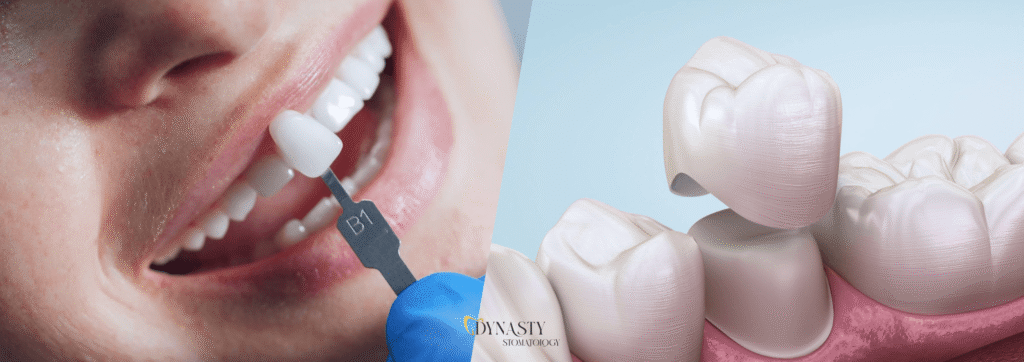
A microdenture is a small dental prosthesis used to replace partially missing teeth. Compared with a conventional acrylic denture, it has a smaller palatal plate in the upper jaw or a limited base, which may make it less noticeable in the mouth.
This solution is intended primarily for adult patients who still have some of their natural teeth and are looking for a discreet, removable replacement. At Dynasty Stomatology, we establish the treatment plan after an examination, bite assessment, and discussion of the patient’s expectations.
What is a microdenture and who is it a good option for?
A dental microdenture replaces one or several missing teeth using the smallest possible construction. It may rest on the patient’s natural teeth, known as abutment teeth, and be retained with clasps, attachments, or a suitably designed base.
A small dental prosthesis is not one universal type of appliance. Its material, retention method, and extent are selected by the prosthodontist based on the number of missing teeth, gum condition, and oral conditions. For people searching for “microdenture Krakow,” the most important question is usually whether the appliance will be stable and comfortable in their particular case.
When is it worth considering a microdenture?
A microdenture is worth considering when one tooth or several teeth are missing, especially if stable abutment teeth remain in the dental arch. It is sometimes chosen by people who do not tolerate an extensive palatal plate well, have a pronounced gag reflex, or expect a less visible removable solution.
Its thin construction may also suit specific anatomical conditions. However, it does not replace proper diagnostics. Before recommending a specific solution, the dentist assesses the teeth, gums, bite, and the possibility of retaining the denture.
When is a microdenture not the best choice?
A microdenture may not be appropriate if there are no suitable supporting teeth, the abutment teeth are loose, or periodontal conditions require treatment first. The choice is also determined by the location of the missing teeth, chewing forces, and the expected durability of the solution.
In some situations, a dental bridge, an implant with a crown, or another removable denture may be a better option. It is not advisable to choose the smallest appliance solely for aesthetic reasons – bite stability and safety are equally important.
Types of dental microdentures
Acrylic, thermoplastic, and metal-framework microdentures differ in material, flexibility, and retention method. Each option has different uses, so the term “small denture” alone does not determine its characteristics.
Acrylic and thermoplastic microdentures
Acrylic microdentures are made from specially modified acrylic materials. Flexible microdentures may be made from durable thermoplastic resins. When a single tooth is missing, a microdenture with one tooth on a thermoplastic base may be possible.
| Feature | Acrylic microdenture | Thermoplastic microdenture |
|---|---|---|
| Material | Modified acrylic material | Flexible thermoplastic resin |
| Retention | Base and retaining elements selected for the individual situation | Flexible base, depending on the design |
| Appearance | Tooth colour and denture elements matched individually | Often a discreet base |
| Typical use | Partial tooth loss | Selected small restorations, including a single tooth |
Lightweight acetal or Acroflex dentures without metal components may also be an alternative. However, this does not mean they are better for every patient – the final choice requires an examination.
Metal-framework microplate denture
A microplate denture may have a metal supporting framework, made, among other materials, from a cobalt-chromium alloy. Its components include a small palatal plate, clasps or attachments, and a framework that reinforces the entire appliance.
The framework makes it possible to reduce the size of the appliance while maintaining its strength. Clasps or attachments secure the denture to natural teeth, which is why their condition is crucial to treatment success. The visibility of retaining elements and wearing comfort are discussed before the appliance is made.
Advantages and limitations of a microdenture
The main advantage of a microdenture is its smaller size compared with a full conventional acrylic denture. Less coverage of the palate may improve denture comfort, make it easier to perceive taste and temperature, and reduce the gag reflex.
However, it is not a solution without an adaptation period. The denture must be cleaned regularly, removed as instructed by the dentist, and checked during follow-up visits, especially if pressure, looseness, or discomfort occurs.
Comfort, aesthetics, and everyday use
An aesthetic denture can discreetly replace a gap in the smile, but the first few days require getting used to it. Speech may sound slightly different, and it is best to begin with soft foods and small bites, chewing on both sides.
A thinner plate is especially appealing for people who are sensitive to extensive palatal coverage. Comfort improves with adaptation, but severe pain, sore spots, or difficulty keeping the denture in place should not be ignored – they require a dental check-up.
Price, durability, and construction limitations
Microplate dentures are usually more expensive than traditional acrylic dentures because they require precise fabrication and may include a metal framework. The cost also depends on the number of teeth being replaced, the material, retention method, and laboratory work.
Such a construction often serves as an intermediate or temporary solution for patients who still have some of their natural teeth. Its durability depends on fit, hygiene, follow-up appointments, and changes that occur in the mouth over time.
Check the current Dynasty Stomatology price list. We provide an exact quote after the consultation and treatment planning.
How is a microdenture made in Krakow?
The process of making a microdenture includes a consultation, diagnostics, planning the construction, taking impressions or an intraoral scan, the laboratory stage, and a fitting appointment. The number of visits depends on the clinical situation and the possible need for prior treatment of the teeth or gums.
At Dynasty Stomatology, we use on-site diagnostics, including digital X-rays, CT scans, and 3D scanning when indicated in the treatment plan. This allows the prosthodontist to assess the supporting conditions and fit of the future restoration.
Consultation and an individual treatment plan
During the prosthodontic consultation, the dentist takes a medical history and examines the oral cavity. They assess the number of missing teeth, supporting teeth, gums, bite, and expectations regarding the appearance and function of the denture.
We then discuss the available options, including a bridge, implant, or microdenture. Before making a decision, the patient receives a clear treatment plan outlining the stages of treatment and the expected costs.
Fitting, delivery, and follow-up
Before delivering the appliance, we check its stability, bite, appearance, and comfort while speaking and closing the mouth. If needed, the dentist makes adjustments to reduce the risk of local pressure points.
After starting to use the denture, it is worth attending a follow-up appointment at the scheduled time. If the denture causes rubbing, shifts, or makes chewing difficult, it should not be filed or bent independently.
Microdenture consultation in Krakow: price and booking an appointment
The price of a microdenture in Krakow depends on the material, number of missing teeth, retention method, preparation of the oral cavity, and scope of laboratory work. During the consultation, we explain whether a given treatment may be provided under public healthcare services or will be private treatment, as well as what the payment schedule looks like.
Dynasty Stomatology offers prosthodontic treatment in Krakow at ul. Romanowicza 1/LU3 and ul. Romanowicza 4B. Patients can receive care in Polish, English, Ukrainian, and Russian. Available instalment payment options include MediPay, MediRaty, and an internal plan – terms are determined individually.
To book an appointment with a prosthodontist, call +48 576 676 266 or use the contact form on the clinic’s website. A prosthodontic consultation in Krakow makes it possible to safely determine whether a microdenture is the right solution for your smile.