In modern dentistry, there are several advanced options for restoring damaged teeth with precision and durability. Inlay, onlay, and overlay treatments offer an effective alternative to traditional fillings or crowns. Understanding their purpose, advantages, and limitations can help you choose the most suitable solution for your dental needs.
What are inlays, onlays, and overlays?
These are types of indirect tooth restorations used when damage is too extensive for a regular dental filling, but a full dental crown is not required.
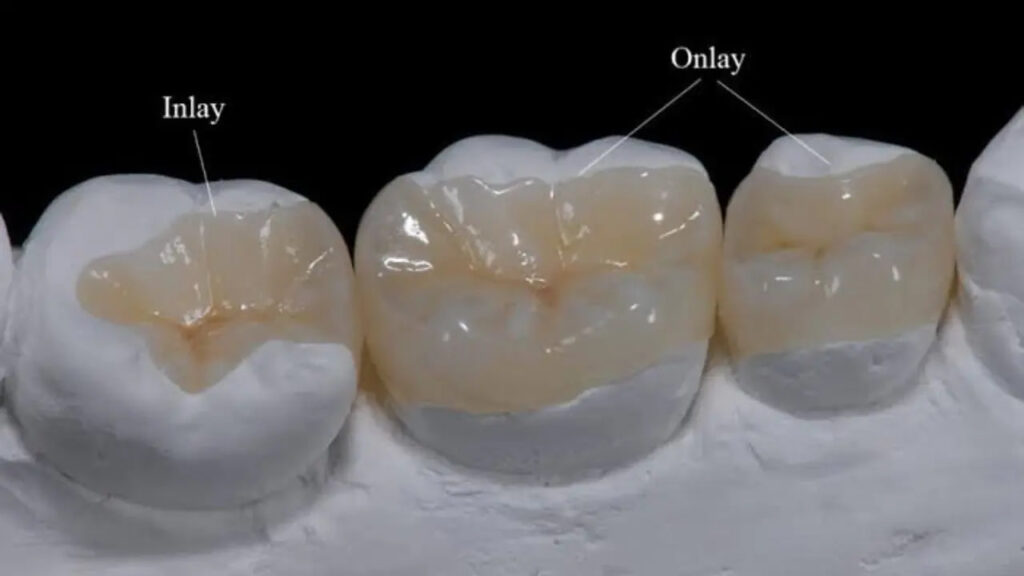
- Inlays fit within the chewing surface of the tooth, without covering the cusps.
- Onlays extend to cover one or more cusps and a larger portion of the biting surface.
- Overlays cover the entire chewing surface, offering more protection while preserving natural tooth structure.
They are usually made of porcelain or composite, custom-crafted in a dental lab, and bonded to the treated tooth using dental cement.
What is the difference between Inlay, Onlay and Overlay?
The main difference between an inlay, onlay, and overlay lies in how much of the tooth they cover. An inlay fits into the cavity and restores the area inside the tooth between the cusps, without covering them. An onlay extends further, covering one or more cusps and part of the biting surface. An overlay offers the most coverage, restoring the entire chewing surface of the tooth, sometimes replacing the need for a full dental crown, while still preserving more of the natural tooth structure.
Inlay, Onlay & Overlay – Pros and Cons
Inlays, onlays, and overlays are often recommended by a dentist when a traditional composite filling is not enough, but a full tooth crown isn’t yet necessary.
Benefits of Inlays and Onlays:
- Preserve more of the natural tooth structure.
- Stronger and more durable than general dental fillings.
- Offer high aesthetics – closely match natural teeth.
- Custom-made in a dental laboratory for precise fit.
- Help rebuild the biting surface of the tooth.
- Provide excellent protection for the deep tissues of the tooth.
- Ideal for tooth decay or fractured areas in part of the tooth.
- Dentists will use dental glue for secure bonding.
- Less invasive than full tooth crown placement.
- Help maintain function and shape of the chewing surface of a tooth.
Cons – Limitations and Drawbacks:
- Require two visits to the dental clinic or dental office.
- Higher cost compared to general fillings.
- May involve longer waiting time (sent to a dental laboratory).
- Temporary onlay or filling may be needed before final placement.
- Not suitable if most of the tooth tissue is missing.
- Risk of detachment if the onlay covers a weak structure.
- Overlay dental restorations may require more extensive reshaping.
- Dentist takes the impression – more complex process.
- Not ideal for small cavities that can be used to fill with simpler materials.
When do you need Inlay, Onlay & Overlay?
You don’t always need a full crown to restore a damaged tooth. In some cases, an inlay, onlay, or overlay is a more conservative and effective solution.
Dentists perform restorations using inlays, onlays, or onlays in the following situations
Inlays are used in the following cases:
- Damage to the chewing surface of a tooth;
- Moderate tooth decay;
- Replacement of old fillings;
- Need for enhanced strength;
- Intact deep tooth tissues;
- Aesthetic restoration.
Onlays are used in the following cases:
- Extensive tooth decay;
- Fractured or cracked tooth;
- Damage involving one or more cusps;
- Weakened tooth structure;
- Replacement of large fillings;
- Preserving natural tooth tissue.
Overlays are used in the following cases:
- Large tooth damage;
- Extensive decay on chewing surface;
- Need to cover the entire biting surface;
- Replace old or damaged restorations;
- Restore worn-down teeth.
Inlay, Onlay & Overlay vs Filling
Inlays, onlays, and overlays differ from traditional fillings by providing stronger and more durable restorations for damaged teeth. While fillings are typically used for small to moderate cavities and applied directly, inlays and onlays are custom-made in a dental laboratory to fit precisely. Overlays cover larger areas, preserving more natural tooth structure compared to fillings. These restorations offer better aesthetics, longevity, and protection, especially for teeth with extensive decay or damage that fillings alone cannot adequately repair.
Inlay, Onlay & Overlay vs Crown
Inlays, onlays, and overlays differ from dental crowns primarily in how much tooth structure they preserve. While crowns cover the entire tooth and require significant reshaping, inlays and onlays are designed to restore only the damaged portion, keeping more of the patient’s natural teeth intact.
Overlays cover a larger chewing surface but still conserve more tooth structure compared with crowns. These restorations are typically made from composite material or porcelain in a dental laboratory and are bonded to the tooth using dental glue, offering a modern dental solution that rebuilds the tooth while preserving its strength.
Types of Inlay, Onlay & Overlay
There are several types of dental inlay, onlay & overlay materials, each with specific benefits depending on the clinical case and patient preferences:
- Gold – durable and long-lasting; ideal for strong back teeth.
- Porcelain – aesthetic and tooth-colored; blends with natural tooth structure.
- Composite – more affordable; used for smaller onlay fillings and temporary solutions.
Each inlay and onlay is typically made by the dentist or lab and bonded with dental glue to the portion of the tooth, preserving structure and function.
Dental inlay, onlay & overlay procedure
The procedure is minimally invasive and aims to restore the tooth while preserving its natural structure.
Main steps:
- Examination at the dental center to assess the structure of the tooth
- Removal of decay and reshaping of the tooth.
- Taking impressions with dental putty or digital scan.
- Placement of a temporary filling or crown if needed.
- Laboratory fabrication (e.g., the inlay is made or dental onlay created).
- Placing the inlay, dental onlay, or overlay filling using dental glue to stick it to the point of the treated tooth.
- Final adjustments to fit the tooth and surrounding area.
This method is suitable when traditional materials used to fill cavities are not sufficient, but a full crown is unnecessary. It’s a conservative solution for getting an inlay, onlay teeth, or overlays that maintain the natural tooth structure intact.
Dental Inlay, Onlay & Overlay alternatives
In cases where damage is minimal, standard inlay fillings or composite restorations may be sufficient. For more extensive issues, full crowns or veneers are often used compared with inlay or dental onlays, depending on the condition of the tooth as well. The main difference is overlays keep more of the natural tooth, making them a conservative option offered by many dental practices.
FAQ
-
Yes, but it’s best to wait until the anesthesia wears off and avoid hard foods for 24 hours after you receive the inlay or onlay.
-
Yes, local anesthesia is typically used to ensure comfort.
-
They may be used in select cases, but fillings are more common for younger patients.
-
Brush and floss regularly and avoid chewing hard objects on the treated tooth.
-
Yes, especially if dental hygiene is poor or the bite changes.
-
Coverage varies, but many dental plans include partial reimbursement.
-
Contact your dental center to have the point of the treated tooth checked.
-
Yes, but whitening won’t affect the color of the restoration.
-
Modern materials are generally biocompatible, but special dental options are available if needed.
-
If the filling is large or failing, an onlay may offer better protection—consult your dentist to assess the difference between the two.