



The absence of several or all teeth is not only an aesthetic issue but also a serious impairment of jaw function, which can lead to reduced chewing ability, bite changes, and even deformation of the facial skeleton. In such cases, it is important to timely restore lost teeth to prevent further complications and improve quality of life.


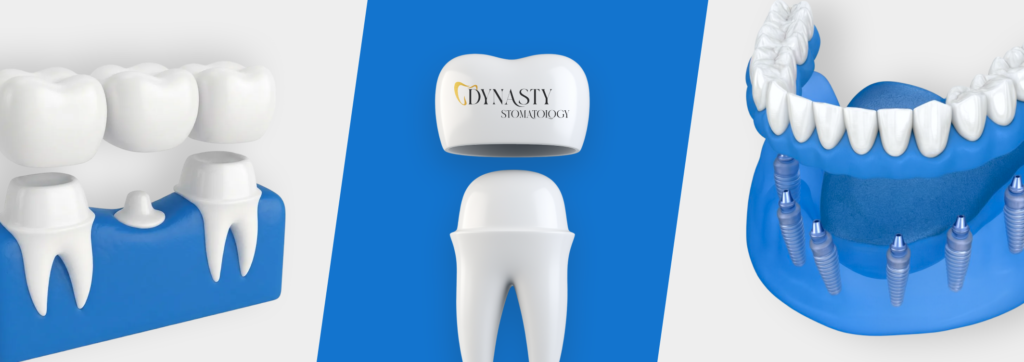
Multi-unit prostheses (screw-retained).

Removable dentures on implants.

Fixed implant-supported prostheses.
Stages of Implant-Supported Prosthetics
Implants and prosthetic restorations are carried out in several structured stages to ensure a successful and functional outcome:
- Consultation and Diagnostics. The process begins with a comprehensive examination, including a CT scan to evaluate bone volume, followed by selection of the appropriate method for restoring the dentition.
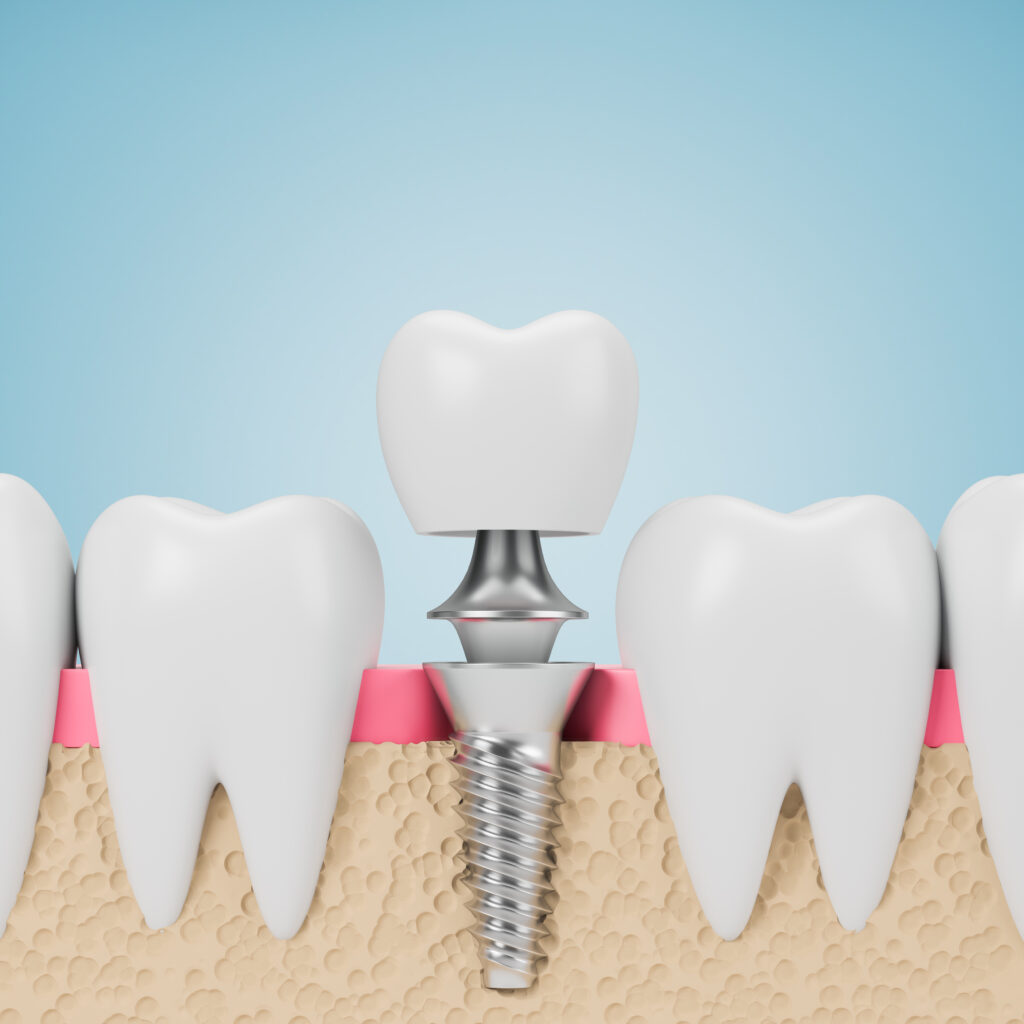
- Surgical Stage – Implant Placement. A titanium implant is inserted into the jawbone during a painless surgical procedure.
- Osseointegration. The healing period allows the implant (artificial root) to integrate with the bone, usually taking 3 to 6 months depending on individual anatomical and maxillofacial factors.
- Placement of the Healing Abutment. This component shapes the gum contour around the future crown or prosthesis, helping to achieve high aesthetics.
- Impression Taking and Prosthesis Fabrication. A dental technician fabricates a custom prosthesis (i.e., a crown, bridge, or full denture), ensuring it matches the patient’s positioned teeth and bite.
- Permanent Prosthesis Attachment. The final crown, porcelain bridge, or full prosthetic structure is attached to the implant with optimal fit and stability.
- Follow-Up and Care Recommendations. The dentist checks the bite and provides individual aftercare instructions to support long-term success.
Implant-supported dentures price in Krakow
-
Prosthodontic consultation
250 PLN -
Tomography of 1 jaw
250 PLN -
Tomography of 2 jaws
350 PLN
Dental implant placement
-
JDental (Italy)
2 500 PLN -
Megagen (South Korea)
4 000 PLN -
Straumann (Switzerland)
5 000 PLN -
Zirconia implant crown
3 300 PLN -
Temporary implant crown
1 200 PLN -
Tooth extraction
310‑800 PLN
How the Dynasty Stomatology dental clinic's loyalty program works
Learn more about the loyalty program
Step 01
Visit the clinic and scan the QR code at the reception desk
Step 02
Register online — enter your details
Step 03
Receive and accumulate points after each visit
Do you want to treat your teeth while you sleep?
Schedule an appointment!
By clicking the button, you give your agreet your personal data in accordance with privacy policy.
Frequently asked questions
-
This is a method of restoring teeth by placing artificial crowns onto titanium roots (implants) surgically embedded into the jawbone.
-
Unlike removable dentures that rely on gums or adjacent teeth, implant prosthetics are fixed onto implants integrated into the bone. This makes them significantly more stable, comfortable, and durable.
-
On average, the entire treatment takes between 3 to 6 months, including implant placement, healing (osseointegration), and final prosthetic attachment.
-
Implant-supported prostheses typically last 10–15 years, and with proper care, even longer. The implants themselves can last a lifetime with routine check-ups and good hygiene.
-
Implant prosthetics refers to custom-made dental restorations — such as crowns, bridges, or full dentures — that are securely attached to dental implants placed in your jawbone. Unlike traditional removable dentures, implant-supported prosthetics feel and function much like your natural teeth, giving you a stable, comfortable, and long-lasting solution for missing teeth. At our clinic, we carefully design each prosthetic restoration to match the shape and color of your natural smile, so you can eat, speak, and smile with full confidence.
-
The 3/2 rule for dental implants is a simple guideline that helps ensure proper spacing: implants should be placed at least 3 mm away from adjacent natural teeth and at least 2 mm away from another implant. This spacing is important to maintain healthy blood supply to the surrounding bone and gum tissue, which supports long-term implant success. Following this rule helps prevent bone loss between implants and teeth, ensuring a stable and lasting result.
-
Dental implants are small titanium posts surgically placed into the jawbone to permanently replace missing tooth roots, onto which a crown is then attached — they look and function just like natural teeth. Prosthetics (such as dentures or bridges) are removable or fixed restorations that sit on top of the gums or are supported by neighboring teeth to replace one or more missing teeth. In short, implants are a long-term, standalone solution anchored in the bone, while traditional prosthetics rely on surrounding teeth or gums for support. During your consultation at our clinic, we'll help you determine which option is best suited to your individual needs and oral health.
-
The cost of implant-supported dentures in Poland is determined individually and depends on the number of implants and the type of restoration. As a guide, a simpler option on 2 implants may cost around PLN 2,600, while treatment for complete tooth loss often exceeds PLN 12,000. An exact estimate can be provided after a consultation and diagnostics.
-
Not always – dentures on 4 implants may be fixed or removable. The number of implants alone does not determine the type of restoration. A fixed bridge and a removable implant-stabilized denture differ in design, hygiene requirements, cost, and clinical indications.
-
It depends on the type of restoration. A removable overdenture is usually taken out for hygiene according to the dentist’s instructions, while a fixed restoration screwed onto implants remains in the mouth and requires cleaning with special brushes as well as an oral irrigator or floss designed for prosthetic work.
-
Implant treatment and implant-supported dentures are usually provided privately. The scope of services reimbursed by the National Health Fund is limited and may change, so before treatment it is worth confirming the current rules directly with the National Health Fund and discussing available payment options with the clinic.
Dentists performing implant-supported restorations
View all doctors
Vladyslav Karkachov
General dentist, endodontist, prosthodontist
Relies on a well-thought-out treatment plan and good rapport with the patient. A friendly approach helps build trust, even among those afraid of de...

Borys Minakov
Prosthodontist
His approach focuses on individually tailored treatment plans that not only solve current issues but also prevent future ones. This helps patients ...

Dmytro Ostrovskyi
Prosthodontist
Over 30 hands-on courses completed in 9 years of practice. A comprehensive approach guarantees stable, durable, and predictable results.
Reviews of implant-supported dentures in Krakow
Expert articles on the topic
View all blog-
19.08.2026
2
10 min. read
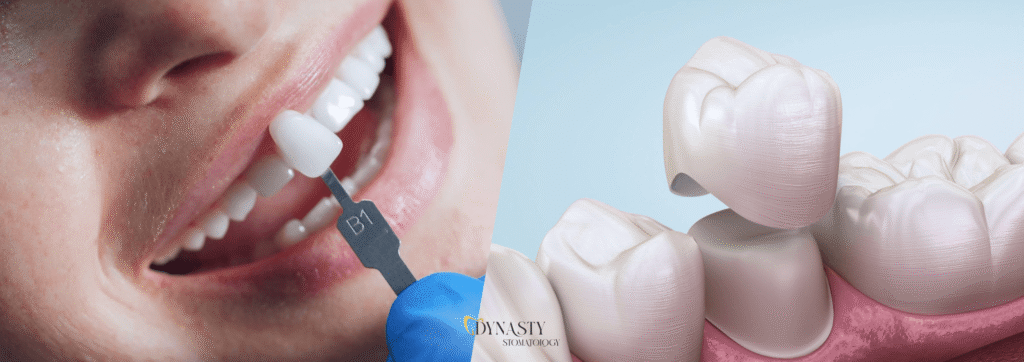
What to choose veneers or crowns – which solution will be better for you?
Veneers or Crowns: The Key Difference A veneer mainly covers the visible front surface of a tooth and is primarily…
Read more -
21.01.2026
506
6 min. read
The Best Dental Restoration Options for Damaged Teeth
When something happens to a tooth, the first reaction is often anxiety. People often assume that treatment will be expensive…
Read more -
06.01.2026
490
8 min. read
Dental Prosthetics – The Secret to a Beautiful Smile
A healthy smile isn’t just about looking perfect. It’s about how comfortable you are when you eat, how freely you speak, and how confident you feel when you smile. After all, if you have chips, cracks, or missing teeth, your lifestyle changes. That’s why dental prosthetics plays a crucial role in restoring your sense of […]
Read more -
09.12.2025
1295
5 min. read
What is Dental Splinting and How It Can Save a Loose Tooth?
Loose teeth in adults are often a sign that something important is changing in your mouth. This causes a lot…
Read more -
31.07.2025
1868
6 min. read
What is Inlay, Onlay and Overlay in dental restoration – pros & cons, purpose and cost
In modern dentistry, there are several advanced options for restoring damaged teeth with precision and durability. Inlay, onlay, and overlay…
Read more -
24.07.2025
1101
10 min. read
Dental Crowns: Types, Costs, and the Procedure
Dental crowns play a vital role in restoring the strength, function, and appearance of damaged or weakened teeth. Whether due…
Read more





How Much Do Implant-Supported Dentures Cost?
The cost of implant-supported dentures depends mainly on the number of implants, the type of restoration, and the condition of the mouth before treatment. As a general guide, simpler solutions may start at around PLN 2,600, while full rehabilitation of an edentulous upper or lower jaw usually costs considerably more.
The estimate is affected by diagnostic imaging, any necessary treatment of remaining teeth, implant placement, connecting components, the restoration material, and follow-up appointments. An implant-stabilized removable denture has a different cost from a fixed porcelain or zirconia bridge.
For patients considering treatment in Krakow, the most important step is an implant consultation with a treatment plan. Only an examination, X-rays, or a CT scan can safely determine the number of implants needed, the extent of preparation required, and the actual cost.
Implant-Supported Denture Price List: Comparing Options
The amounts below are indicative only. A treatment plan may include a consultation, diagnostics, implants, healing screws, prosthetic abutments, fabrication of the denture or bridge, and check-ups. If necessary, the cost may also include cavity treatment, root canal treatment, tooth extraction, or bone preparation.
| Number of implants | Type of restoration | Estimated cost | What may affect the estimate |
|---|---|---|---|
| 2 implants | Usually an attachment-retained removable denture, more commonly in the lower jaw | from approx. PLN 2,600 for the indicated prosthetic scope | type of attachments, diagnostics, bone condition, implant placement cost |
| 4 implants | A stabilized denture or full-arch restoration, depending on indications | individual estimate | restoration material, need for preparatory procedures, number of appointments |
| 6 implants | An extensive full-arch restoration | approx. PLN 30,000 | bridge type, materials, bone and surgical conditions |
| Complete tooth loss | Comprehensive implant-prosthetic treatment | often over PLN 12,000 | extent of surgery, temporary and final denture, diagnostics |
At Dynasty Stomatology, we discuss the treatment plan and costs in stages, without recommending procedures that are not clinically necessary. For more extensive treatment, it is also worth asking about available installment payment options, including MediPay, MediRaty, or an internal payment plan, the terms of which are determined individually.
How Much Do Dentures on 2 and 4 Implants Cost?
Dentures on 2 implants may cost around PLN 2,600; however, depending on the scope of treatment, the price may rise to several thousand PLN. This option is not a universal solution for every dental arch or every patient.
In cases of complete tooth loss, good denture retention can often be achieved with 2 implants in the lower jaw and 4 implants in the upper jaw. Eligibility depends, among other factors, on the quantity and quality of bone, the bite, tissue condition, and expectations regarding a fixed or removable restoration.
How Much Do Dentures on 6 Implants Cost and What About Complete Tooth Loss?
Treatment for complete tooth loss may cost more than PLN 12,000, especially when it includes implant placement and a new prosthetic restoration. A denture or bridge supported by 6 implants costs approximately PLN 30,000.
The starting amount does not always cover complete rehabilitation. The estimate may change if additional surgical procedures, a temporary restoration, or a porcelain or zirconia restoration is needed. Six implants are used when the dentist determines that this will improve stability and the distribution of chewing forces.
Types of Implant-Supported Dentures: Fixed, Removable, and Overdentures
Implant-supported dentures do not always mean a fixed restoration. A patient may receive a permanently screw-retained restoration or a removable denture that is attached to implants but can be taken out independently for daily cleaning.
An overdenture is precisely a removable denture supported by implants. It is usually held in place with attachments or a bar, making it more stable than a conventional acrylic denture that rests solely on the gums.
Fixed Implant-Supported Dentures
A fixed implant-supported denture is screw-retained or cemented by the dentist and, for many people, provides a feeling most similar to natural teeth. It makes biting easier, does not shift while speaking, and does not need to be removed at night.
This solution is usually more expensive than an acrylic denture because it requires more complex surgical and prosthetic work. Depending on the treatment plan, materials such as porcelain and zirconia restorations may be used. A fixed restoration still requires very thorough cleaning around the implants.
Removable Dentures Attached to Implants
A removable denture may be attached to implants using attachments. The implants limit movement of the denture, increase confidence while eating, and help control its position during speech.
This option is sometimes chosen by people who want to improve the stability of a conventional denture while still preferring to remove it for cleaning. An adaptation period is needed at first, especially when learning to speak and bite harder foods.
Who Are Implant-Supported Dentures For?
Implant-supported dentures are considered for people with complete tooth loss, patients dissatisfied with the stability of an acrylic denture, and people with partial tooth loss. An implant is a small fixture placed in the bone that performs a function similar to the root of a lost tooth.
Implants can be placed in the upper and lower jaw. Not every patient is eligible for the same treatment approach, so the decision is made by the dentist after an examination and diagnostic review. Important factors include oral health, bone conditions, hygiene, smoking, general medical conditions, and medications taken.
Before starting treatment, it is worth discussing the benefits, limitations, potential preparatory procedures, and the expected way the denture will be used. The principles of eligibility and long-term implant care are also described by the European Association for Osseointegration.
Examinations and Preparation for Treatment
The consultation includes a medical history, an oral examination, and diagnostic imaging. At Dynasty Stomatology, we provide on-site diagnostics, including digital X-rays, CT scans, and intraoral scanning when needed to plan treatment.
Before implant placement, active dental problems must be treated. Remaining teeth may require cavity treatment, microscope-assisted root canal treatment, or extraction if they cannot be predictably restored. This is important for treatment safety and may affect the total cost.
What Does Implant-Supported Denture Treatment Involve?
Implant-prosthetic treatment takes place in stages. The number of appointments and healing time depend on the clinical situation, so one schedule should not be assumed for all patients.
- Consultation and diagnostics – the dentist assesses the oral cavity, bone conditions, and the patient’s needs.
- Treatment plan and estimate – we discuss the number of implants, the type of restoration, appointments, and costs.
- Oral preparation – this includes dental treatment, professional hygiene treatment, or other necessary procedures.
- Implant placement – the procedure is performed under local anesthesia, and additional anxiety-reduction methods can be discussed when indicated.
- Healing and check-ups – the implant integrates with the bone, while the dentist monitors the process.
- Fabrication of the prosthetic restoration – after scans or impressions are taken, the denture, bridge, or crowns are made.
How Many Implants Are Needed for a Full Upper Jaw Denture?
For stable denture retention, 4 implants in the upper jaw and 2 implants in the lower jaw may be sufficient. However, these are general approaches rather than a ready-made solution for every patient.
When planning a full-arch restoration, solutions based on four or six implants are used. A greater number of implants may be indicated when required by force distribution, available bone, or the planned prosthetic design. The final decision is made by the dentist after reviewing the examination and 3D imaging.
Restorations for Partial Tooth Loss
With partial tooth loss, the aim is not to make a complete denture but to replace one or several missing teeth. An implant can support a single crown or a bridge replacing a larger gap.
If the patient has remaining teeth, special prosthetic abutments and porcelain bridges can be used. The plan should protect the remaining teeth and allow daily cleaning of the restoration. The choice between a crown, bridge, and denture depends on the number of missing teeth and the condition of adjacent teeth.
Advantages of Implant-Supported Dentures and Limitations Worth Knowing
Implant-supported dentures are more stable than conventional removable dentures supported only by the gums. For many patients, this means greater confidence while speaking and eating, no need to use denture adhesive, and a more natural appearance of the restoration.
Implants transfer some chewing forces to the bone, which may help limit bone changes associated with tooth loss. However, they do not stop every biological process and do not eliminate the need for check-ups. The health of tissues around implants depends, among other things, on hygiene, regular appointments, and a properly designed restoration.
A well-maintained implant-supported denture can last for many years, and sometimes for a lifetime, but the implants themselves and prosthetic components require check-ups and periodic maintenance. Plaque buildup, gum inflammation, bruxism, and smoking may worsen the prognosis. Recommendations for preventing diseases around implants are published by the European Federation of Periodontology.
Consultation and Pricing for Implant-Supported Dentures at Our Clinic
During a consultation at Dynasty Stomatology, we assess treatment options, discuss the type of restoration, the proposed number of implants, the appointment plan, and an individual estimate. The patient receives clear information about the stages of treatment, hygiene, possible limitations, and financing options.
We see patients in Krakow at Romanowicza 1/LU3 and Romanowicza 4B. Our team communicates in Polish, English, Ukrainian, and Russian, which may make it easier for international patients to discuss a complex treatment plan.
Questions regarding installments, potential financing, and reimbursement should be confirmed individually before treatment begins. Implant-supported dentures are generally private treatment, and current public benefit rules should be checked directly with the National Health Fund.