



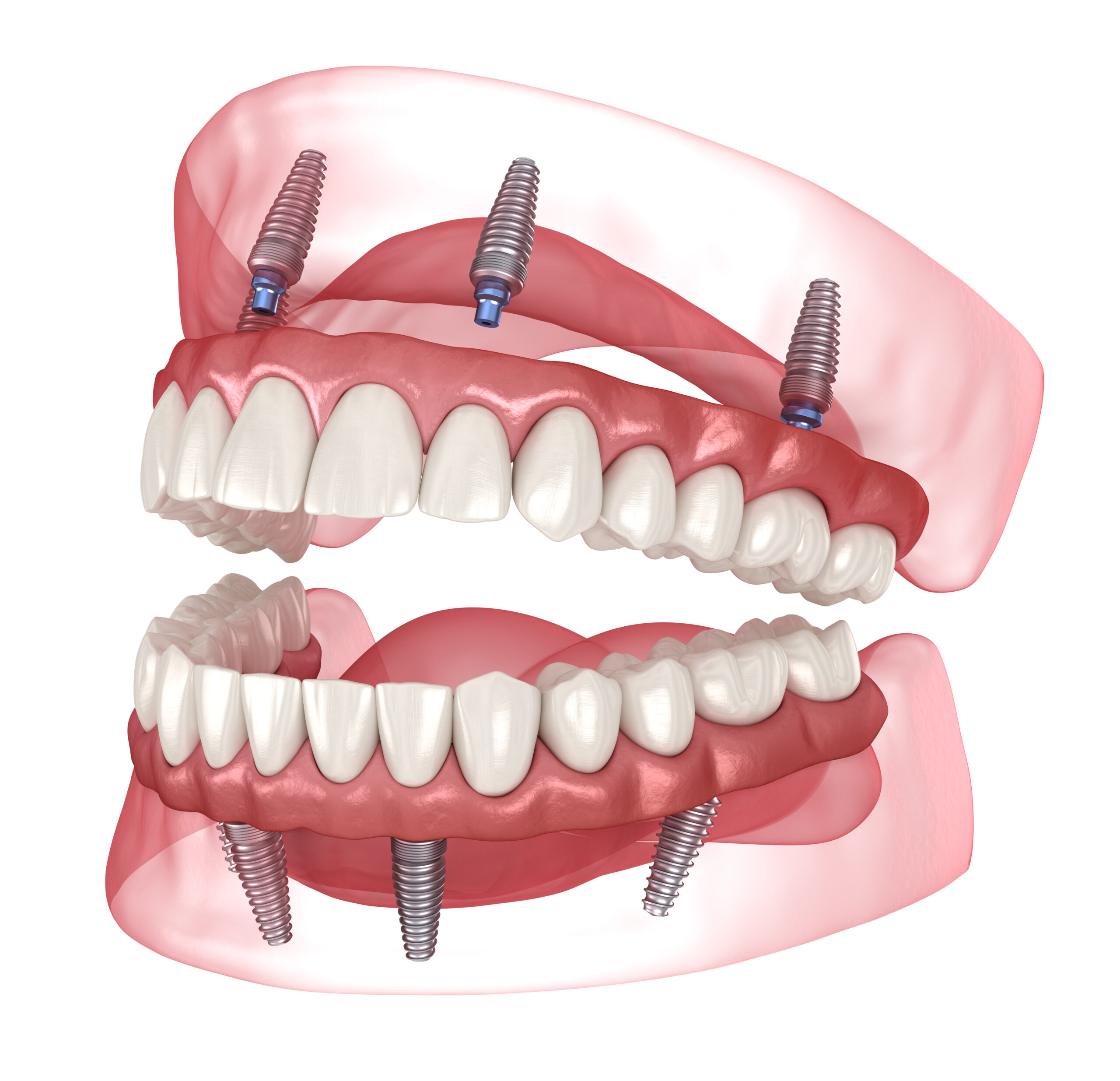
All-on-4 implants is a modern solution for restoring a full arch of missing teeth using just 4 implants. This innovative implantation technique provides fast functional and aesthetic results with minimal trauma and time investment. The all-on-4 treatment is especially popular due to its accessibility and the possibility of fitting a temporary prosthesis on the same day.

Initial consultation and diagnostics, Oral preparation

Surgical template creation, Surgical phase

Temporary prosthesis, Postoperative care
Benefits of All-on-4 Implants at Dynasty Stomatology
At Dynasty Stomatology, we perform All-on-4 implantation using advanced technologies and a personalized approach. With us, you get with All-on-4 not just replacement teeth, but comfort, reliability, and care at every step. Our advantages include:
- Experienced implant surgeons with years of practice;
- Use of premium-quality, original implants from trusted brands;
- Accurate diagnostics and digital treatment planning for predictable results;
- Painless procedures thanks to modern anesthesia;
- Prosthesis can be fitted within a minimal time after surgery;
- Customized treatment plans and full patient support throughout the process;
- Comfortable recovery conditions and follow-up care;
- Transparent pricing with no hidden fees.
Schedule your free initial consultation at Dynasty Stomatology and find the best solution to restore your teeth and smile using 4 implants. Teeth are replaced quickly and efficiently — regain confidence and full dental function today!
Contact us today to learn about available payment plans and opening hours.
Price: All-on-4 – denture on 4 implants Krakow
-
Periodontologic consultation + treatment plan
300 PLN -
Tomography of 1 jaw
250 PLN -
Tomography of 2 jaws
350 PLN
Dental implant placement
-
JDental (Italy)
2 500 PLN -
Megagen (South Korea)
4 000 PLN -
Straumann (Switzerland)
5 000 PLN -
Non-removable temporary denture on implants
6 000 PLN -
Non-removable permanent denture on implants
20 000 PLN -
Tooth extraction
310‑800 PLN -
8-th tooth extraction
530‑2 000 PLN
How the Dynasty Stomatology dental clinic's loyalty program works
Learn more about the loyalty program
Step 01
Visit the clinic and scan the QR code at the reception desk
Step 02
Register online — enter your details
Step 03
Receive and accumulate points after each visit
Do you want to treat your teeth while you sleep?
Schedule an appointment!
By clicking the button, you give your agreet your personal data in accordance with privacy policy.
Frequently asked questions about All-on-4 implants
-
The All-on-4 method uses only 4 implants to support a full arch of teeth. In comparison, traditional dental implants vs All-on-4 typically require a higher number of implants (e.g., All-on-6 uses 6). All-on-4 offers a faster, less invasive option without extensive bone augmentation, making it ideal for many patients.
-
As with any surgical procedure, there are some risks such as implant rejection, inflammation, or delayed healing. However, when performed by an experienced surgeon and with proper aftercare, complications are rare.
-
The surgical procedure usually lasts 2 to 4 hours. A temporary prosthesis can be fitted within the same day. Initial recovery takes a few days, while full integration of the implants can take 3 to 6 months, depending on the patient.
-
All-on-4 implants are a great long-term solution. With proper care, they can last 10 to 20 years or more. Durability depends on the quality of the implants, oral hygiene, bone condition, and adherence to your dentist’s recommendations.
-
After surgery, patients should avoid hard or sticky foods, reduce stress on the implants, and stop smoking to promote healing. It’s also essential to maintain excellent oral hygiene and attend regular dental check-ups.
-
Most patients feel significantly better within 1–2 weeks after the All-on-4 procedure, with mild swelling and discomfort typically subsiding within the first few days. You can usually return to normal daily activities within a week, though we recommend eating soft foods for the first few months while your implants integrate with the jawbone. Full healing and osseointegration generally take 3–6 months, after which your permanent prosthesis is placed. Our team at Dynasty Stomatology will guide you through every step of your recovery to ensure the best possible outcome.
-
Yes, small food particles can sometimes get trapped under an All-on-4 prosthesis, as there is a slight gap between the bridge and the gum tissue by design — this space is necessary for proper hygiene and tissue health. However, this is easily managed with daily cleaning using a water flosser, interdental brushes, or a soft-bristle toothbrush to keep the area clean and comfortable. Regular check-ups at our clinic will also help ensure everything stays in great condition and fits properly over time.
-
The All-on-4 treatment can often be completed in just one day — you can receive a full set of temporary fixed teeth on the same day as your implant surgery. The entire process, from initial consultation and planning to the placement of your final, permanent prosthesis, typically takes 3 to 6 months, as the implants need time to fully integrate with your jawbone. During this healing period, you'll wear a comfortable temporary bridge so you're never without teeth.
-
The All-on-4 treatment in Poland typically costs between 4,000–6,500 EUR per arch, depending on the type of implants and prosthetic materials used. This is significantly more affordable compared to Western Europe or the US, where the same procedure can cost 15,000–25,000 EUR or more. For a personalized quote tailored to your specific needs, we invite you to schedule a free consultation at our clinic — we'll assess your situation and provide a detailed treatment plan with transparent pricing.
-
The price of All-on-4 for one arch is determined after examination and diagnostics. The cost depends, among other things, on the need for extractions, the type of anesthesia, the scope of tests, the temporary restoration, and the final bridge. It is best to request a written cost estimate covering all stages.
-
That depends on the scope of the specific offer and cost estimate. The estimate should separately confirm whether it includes the temporary bridge fitted after the procedure and the final bridge made after healing. It is also worth confirming the materials, follow-up appointments, and any additional costs.
-
All-on-4 should be treated as private treatment, and any scope of reimbursement must be confirmed individually. You should not assume that the National Health Fund or private insurance will cover implants and a fixed restoration. Before starting treatment, it is worth obtaining information directly from the payer.
Specialists who perform All-on-4 implant procedures
View all doctors
Kostiantyn Danyliuk
Oral Surgeon, Implantologist
Konstantin is a skilled specialist who combines in-depth knowledge and cutting-edge technology to achieve the best results. He maintains active com...

Borys Minakov
Prosthodontist
His approach focuses on individually tailored treatment plans that not only solve current issues but also prevent future ones. This helps patients ...

Dmytro Ostrovskyi
Prosthodontist
Over 30 hands-on courses completed in 9 years of practice. A comprehensive approach guarantees stable, durable, and predictable results.
Reviews of All-on-4 implants in Krakow
Expert articles on the topic
View all blog-
05.06.2026
332
10 min. read
Dental Implants – What You Should Know
Tooth loss is a situation faced by people of all ages. Some put off treatment for months, becoming accustomed to…
Read more -
11.05.2026
352
9 min. read
What is Teeth in a Day – Steps Of The Immediate Implantation Procedure
Just a few years ago, losing a tooth meant a long and unpleasant process: extraction, months of waiting, temporary solutions,…
Read more -
26.02.2026
427
11 min. read
What is Dental Implant Procedure — A Complete Guide
Losing a tooth isn't always just about aesthetics. It's about self-confidence, the ability to smile without tension, the ability to…
Read more -
30.10.2025
544
7 min. read
How long does a dental implant last?
If you are reading this article, most likely you have already made an important decision: to replace a lost tooth with an implant. But somewhere inside there is still a doubt: “What’s next? Will I have to redo everything in a year or two?“ These are absolutely normal questions. Because when you choose implantation, you […]
Read more





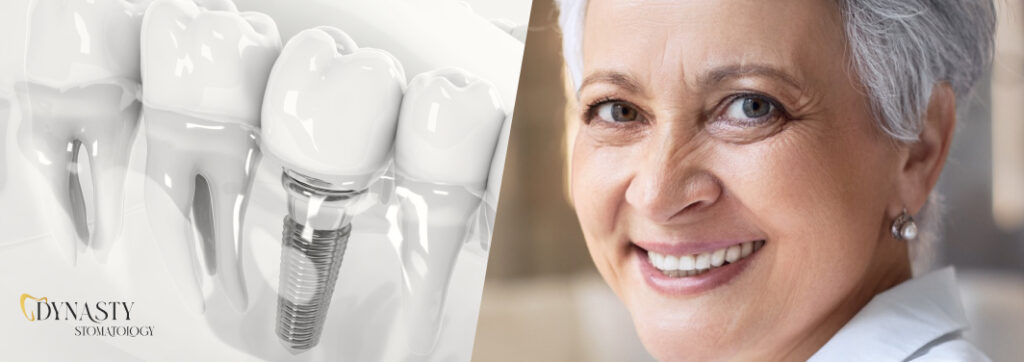
This guide is for people with complete tooth loss or extensive missing teeth who are considering a fixed restoration in Krakow and want to understand the cost of All-on-4. The cost is not a single fixed amount: it depends on diagnostics, the condition of the oral cavity, the scope of surgery, and the type of prosthetic restoration. At Dynasty Stomatology, we discuss the treatment plan and cost estimate before the procedure begins.
How much does All-on-4 cost and what does the price depend on?
The price of All-on-4 is determined individually after consultation and diagnostics because it includes both the surgical and prosthetic stages. A reliable estimate should indicate exactly what the patient receives as part of treatment for one dental arch and what is charged separately.
Rather than comparing only the final amount, it is worth asking for a written treatment plan. It allows you to check the scope of services, schedule, and expected payment stages. Current information can also be confirmed in the Dynasty Stomatology price list.
What does the cost of All-on-4 treatment include?
In the cost estimate, it is worth checking whether the price includes:
- an implant consultation and treatment plan,
- X-rays or CBCT scans,
- possible tooth extractions,
- the surgical procedure and four implants,
- local anesthesia, sedation, or general anesthesia, if indicated,
- fabrication and fitting of a temporary bridge,
- the final bridge after the healing period,
- follow-up appointments and professional dental hygiene treatment.
Not every clinic includes all of these elements in one price. Diagnostics, tooth removal, anesthesiology care, the final bridge, or follow-up appointments may be priced separately. Before making a decision, it is worth asking directly: “Is this the full treatment cost or the price of one stage?”
What factors increase or decrease the cost of All-on-4?
The most important difference concerns whether one dental arch or both arches are being restored. Comprehensive rehabilitation of the upper and lower jaw involves a greater scope of surgical and prosthetic work than treatment of a single arch.
The cost of the All-on-4 procedure is also affected by the condition of the bone and gums, the need for tooth removal, the type of anesthesia, the bridge material, the scope of diagnostics, and the frequency of follow-up visits. Only offers with the same scope are comparable—a lower price may not include the final bridge, tests, or post-procedure care.
What is the All-on-4 method and what does the patient receive?
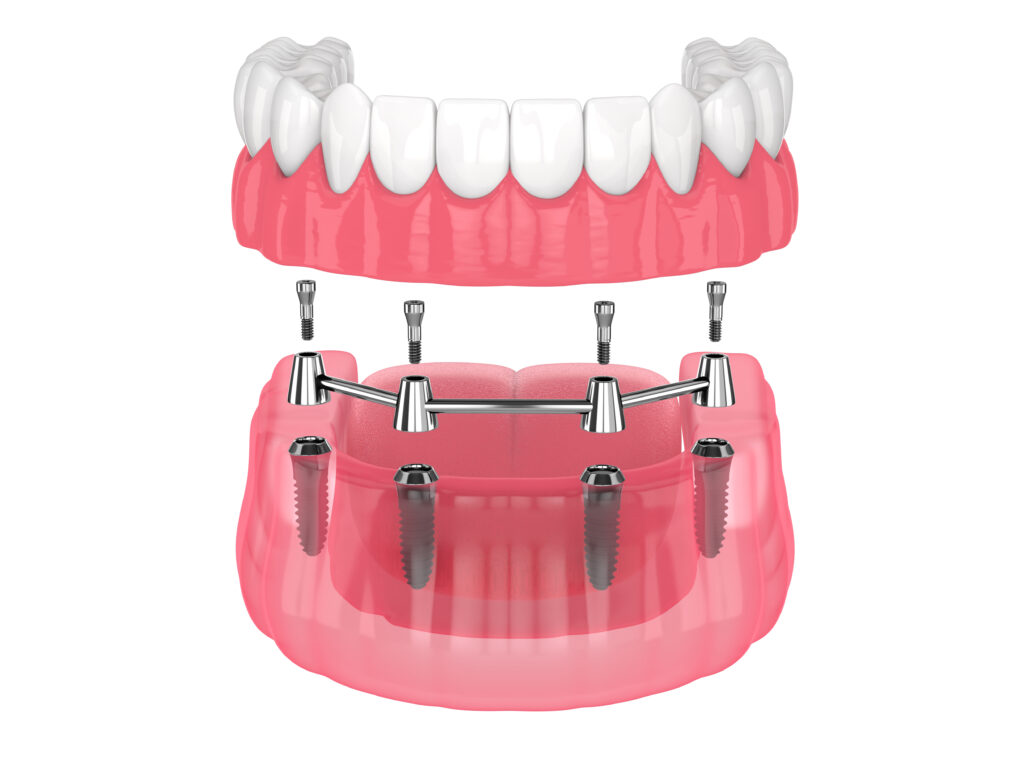
All-on-4 is a fixed restoration of an entire dental arch supported by four implants and a prosthetic bridge. It is not a conventional removable denture taken out at night, but a restoration fixed to implants by a dentist.
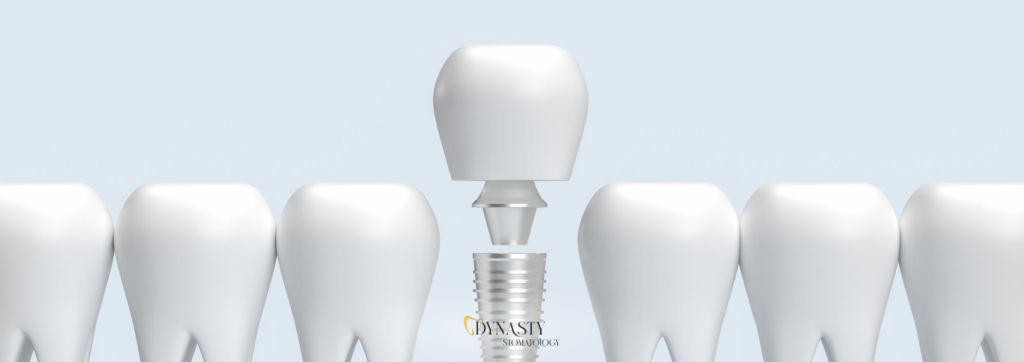
The implants serve as foundations placed in the bone, while the bridge recreates the visible part of the teeth. Immediately after the procedure, the patient receives a temporary restoration, while the final bridge is fitted after healing is complete.
Four implants and an immediate temporary restoration
The All-on-4 method involves placing four implants that support the prosthetic bridge. This type of planning may make treatment possible even for people with limited bone volume, but eligibility is always determined by the dentist after an examination and imaging analysis.
A temporary bridge may be fixed after the procedure. According to the clinical plan used, the temporary restoration is most often made of zirconia and porcelain. The decision on immediate loading of the implants is made by the dentist, taking into account implant stability and conditions in the oral cavity.
Who is All-on-4 a suitable solution for?
All-on-4 is considered primarily for people with complete tooth loss, extensive missing teeth, or teeth that can no longer be safely preserved. It may be a solution for patients who do not want to use a removable denture.
However, a description of symptoms is not enough to determine eligibility. An examination, medical history, and imaging diagnostics are necessary to assess treatment safety.
Indications and eligibility requirements
Indications may include complete tooth loss, the need to remove all remaining teeth, or significant tooth loss in the upper jaw. During the consultation, the dentist assesses the condition of the bone, gums, bite, oral hygiene, and general health.
People who have been told they are not eligible for traditional implants may also schedule a consultation. In All-on-4, the placement of implants and the bridge design are planned individually based on diagnostic tests.
When should treatment be postponed or another option considered?
Contraindications for All-on-4 include advanced bone inflammation, cancer, uncontrolled diabetes, age under 18, and pregnancy. This list should not be used to rule yourself out of treatment.
Some health issues first require treatment, stabilization, or consultation with the doctor managing your care. The final decision is made by the implantologist after taking a medical history, performing an examination, and reviewing diagnostics.
What does All-on-4 treatment involve step by step?
All-on-4 treatment is a process that includes consultation, planning, surgery, a temporary restoration, and fabrication of the final bridge. From the first stage, the patient should know the possible alternatives, risks, and expected cost.
Consultation, diagnostics, and an individual plan
The first appointment includes a discussion about chronic conditions, allergies, medications taken, and aesthetic and functional expectations. The dentist evaluates the oral cavity and identifies any issues that require prior treatment.
All-on-4 planning includes X-rays or a CBCT scan, a three-dimensional examination that makes it possible to assess the bone and soft tissues. At this stage, the patient receives a treatment plan, information about risks, and an individual cost estimate.
Surgical procedure and anesthesia
During the planned procedure, the dentist may remove teeth if necessary and then place the implants. The procedure may be performed under local anesthesia, sedation, or general anesthesia.
Sedation and general anesthesia may be considered for people with severe dental anxiety. They require prior eligibility assessment, appropriate preparation, and supervision by an anesthesiologist. The team selects the method of pain and anxiety control according to the patient’s health condition and does not promise identical experiences for every person.
Temporary bridge, healing, and final bridge
The temporary bridge allows the patient to function during the healing period, but it requires following recommendations regarding hygiene, diet, and follow-up visits. It should not be treated as the final prosthetic restoration.
The final bridge is fitted after the healing process has been assessed. Healing usually takes around 6 months in the upper jaw and around 3 months in the lower jaw. These timeframes may change if the dentist determines that the tissues need more time.
Can teeth be restored in one day?
Yes, in eligible patients, All-on-4 may allow restoration of a full dental arch on the day of the procedure. The visual and functional effect of a temporary bridge may be visible just a few hours after leaving the office.
However, “one day” does not mean that the entire prosthetic treatment is complete. After the healing period, the temporary restoration is replaced with a final bridge prepared based on clinical follow-up examinations.
Benefits and limitations of an All-on-4 prosthesis
All-on-4 can improve restoration stability, comfort when speaking and eating, and the appearance of the smile. However, it requires daily hygiene, regular check-ups, and conscious adherence to post-procedure recommendations.
This solution is not identical to natural teeth and should not be chosen solely because of the speed of restoration. The best decision is made after comparing clinical possibilities, costs, and expectations.
Stability, aesthetics, and everyday comfort
A bridge supported by implants is intended to provide stable support and limit movement of the restoration. For many people, this means greater comfort when speaking, eating, and smiling than with a conventional removable denture.
However, the result depends on proper planning, the quality of oral hygiene, and regular follow-up visits. The patient should learn how to clean the space under the bridge and report any pain, bleeding, looseness of the restoration, or bite changes.
Does All-on-4 always make it possible to avoid a bone graft?
All-on-4 usually eliminates the need for bone regeneration or a bone graft. This is one reason why the method may be considered in cases of limited bone volume.
The word “usually” is important. Every case requires CBCT assessment because bone structure, inflammation, and the planned implant position may affect the scope of treatment. The European Association for Osseointegration publishes materials on implant treatment and diagnostic-based planning.
All-on-4, All-on-6, or a removable denture—what should you choose?
The choice between All-on-4, All-on-6, and a removable denture should be based on examination findings, bone quantity and quality, bite conditions, and the prosthetic plan. A greater number of implants is not automatically better for every patient, just as a lower cost does not determine whether a solution is cost-effective.
| Criterion | All-on-4 | All-on-6 | Removable denture |
|---|---|---|---|
| Support | 4 implants | 6 implants | Oral tissues |
| Stability | Fixed restoration attached to implants | Fixed restoration attached to implants | May move |
| Scope of procedure | Implant surgery | Implant surgery with a greater number of implants | Usually without implant placement |
| Bone requirements | Assessed individually | Assessed individually | Lower surgical requirements |
| Hygiene | Brushing and cleaning under the bridge | Brushing and cleaning under the bridge | Daily removal and cleaning |
| Treatment time | A temporary bridge may be possible on the day of the procedure | Depends on the treatment plan | Depends on denture fabrication |
| Cost factors | Implants, surgery, bridges, and follow-up visits | Usually a broader implant treatment scope | Usually a different, less surgical scope |
All-on-6 may be considered when anatomical conditions and the restoration plan indicate a need for additional support. A removable denture may be an appropriate option for people who are not eligible for implants or choose less invasive treatment. The dentist selects the solution based on diagnostic findings, not price alone.
How long do All-on-4 implants and bridges last?
Implants and prosthetic components are different parts of treatment and may require different care over time. It is not possible to honestly guarantee one service life for every patient.
The long-term function of the restoration is affected by hygiene, the condition of the gums and bone, tobacco use, general health, bite forces, and regular follow-up appointments. The bridge may require periodic adjustments, repairs, or replacement of wear components.
After the procedure, you should follow the dietary recommendations provided by the dentist, especially during the healing period. Daily brushing, cleaning the space under the bridge with recommended tools, and professional hygiene appointments at scheduled intervals are necessary. Bleeding gums, pain, unpleasant odor, bridge mobility, or difficulty biting are signs to contact the clinic promptly.
All-on-4 financing and booking a consultation
An individual All-on-4 cost estimate can be obtained after consultation, diagnostics, and preparation of a treatment plan. At Dynasty Stomatology, we discuss treatment stages and available payment options before the procedure begins.
The clinic is located in Krakow at Romanowicza 1/LU3 and Romanowicza 4B. You can request an appointment through the Dynasty Stomatology contact page or by phone. The team communicates in Polish, English, Ukrainian, and Russian.
Private treatment, reimbursement, and installment payments
Comprehensive All-on-4 implant rehabilitation is private treatment. The scope of any reimbursed services should always be confirmed directly with the National Health Fund or the healthcare provider, as the rules and scope of services may change.[^1]
It is worth asking about the payment schedule, MediPay installments, MediRaty, or an internal payment plan if available for the specific treatment plan. Financing terms are determined individually and do not replace a full cost estimate.
How should you prepare for your first appointment?
Before your consultation, prepare:
- a list of medications you take, allergies, and chronic conditions,
- any dental records and test results you have,
- information about previous implant or prosthetic treatment,
- your own expectations regarding appearance, eating, and comfort,
- questions about alternatives, risks, scheduling, and the total cost.
The consultation makes it possible to determine whether All-on-4 is an appropriate solution in your situation and what scope of treatment will be needed. Book an implant consultation.
[^1]: National Health Fund – official website. Information about reimbursed services requires confirmation according to current National Health Fund rules.