



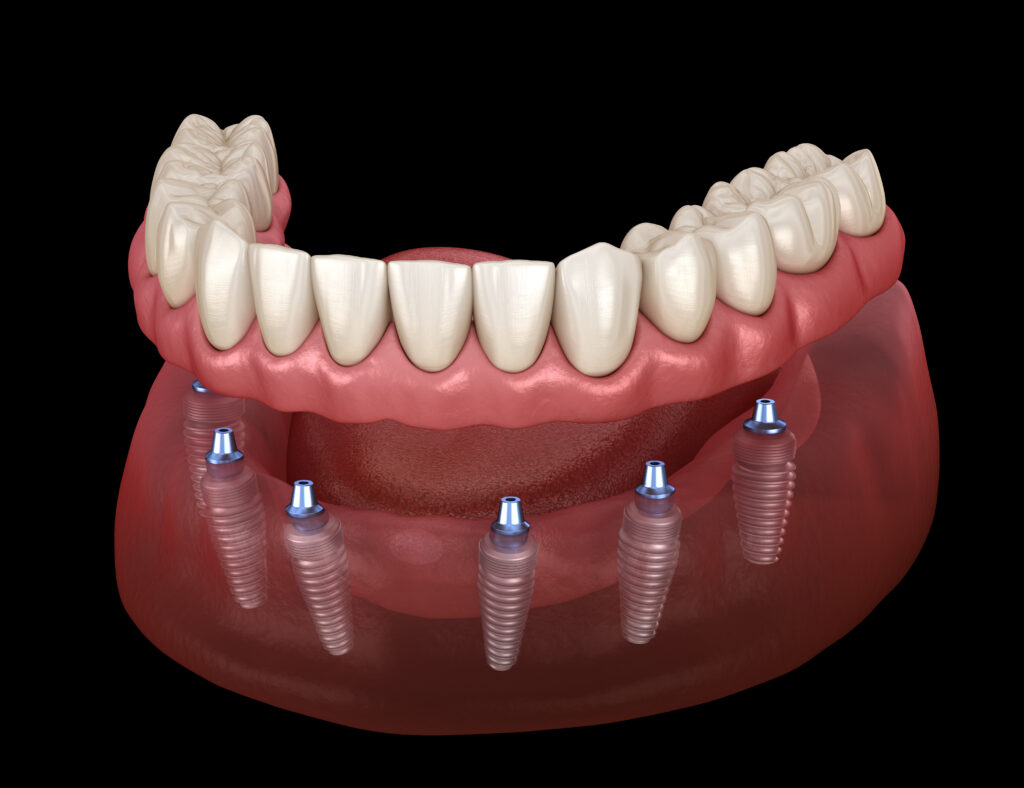
All-on-6 implantation is a reliable and modern method to restore a full arch of teeth on one jaw using six implants. This method allows for secure fixation of a fixed dental prosthesis, restoring full chewing function and a natural smile aesthetic. The procedure is comfortable for the patient and delivers quick results even in cases of significant bone loss.


Restoration of teeth

Minimal surgical intervention

High aesthetic results
Advantages of Implantation at Dynasty Stomatology
Our clinic offers patients a comfortable and painless way to restore your smile and the functionality of the dental arch. Choose Dynasty Stomatology and experience these benefits:
- Experienced specialists who regularly improve their qualifications to offer you the best solutions.
- Modern technologies and the latest equipment for diagnostics and dental surgeries, including 3D modeling and computed tomography, ensuring accuracy and safety.
- An individual approach to each patient, considering their health condition and personal preferences.
- Painlessness and comfort – we use advanced anesthesia techniques and medications.
- Affordable prices and convenient payment options.
Restore your smile without pain and long waiting times using the all-on-6 protocol. Schedule your initial consultation at Dynasty Stomatology at a time convenient for you!
Price: All-on-6 – denture on 6 implants Krakow
-
Prosthodontic consultation
250 PLN -
Tomography of 1 jaw
250 PLN -
Tomography of 2 jaws
350 PLN
Dental implant placement
-
JDental (Italy)
2 500 PLN -
Megagen (South Korea)
4 000 PLN -
Straumann (Switzerland)
5 000 PLN -
Non-removable temporary denture on implants
6 000 PLN -
Non-removable permanent denture on implants
20 000 PLN -
Tooth extraction
310‑800 PLN -
8-th tooth extraction
530‑2 000 PLN
How the Dynasty Stomatology dental clinic's loyalty program works
Learn more about the loyalty program
Step 01
Visit the clinic and scan the QR code at the reception desk
Step 02
Register online — enter your details
Step 03
Receive and accumulate points after each visit
Do you want to treat your teeth while you sleep?
Schedule an appointment!
By clicking the button, you give your agreet your personal data in accordance with privacy policy.
Frequently asked questions
-
The implantation process using the protocol with 6 implants usually takes from 2 to 4 months, including preparation, implant placement, and prosthetics.
-
The all-on-6 is a dental implant solution for patients with full or multiple missing teeth, as well as those who want to restore several teeth on one jaw. This technology allows installing dentures with a moderate bone deficiency, as it does not require extensive surgical interventions.
-
Yes, all-on-6 implants offer a solution for patients of older age, provided there are no contraindications for implant placement, such as conditions that prevent tissue regeneration.
-
The methods all-on-4 vs all-on-6 are based on the same principle; however, the number of implants used in all-on-6 is six instead of four. This ensures more reliable support of the dental prosthesis and an even distribution of load. This is especially important for patients with insufficient bone density, as the additional implant improves the stabilization of the structure. Secondly, the all-on-6 is a dental implant method that reduces the risk of bone damage and provides a more durable result.
-
Restoring teeth with the all-on-6 protocol using structures from Alpha, Nobel, and other trusted manufacturers guarantees durability with proper care and adherence to dentist recommendations. The service life of these constructions can be 15-20 years or more. This longevity is ensured by high-quality materials (titanium base), implantation technology, and stability provided by using 6 implants.
-
The method may carry risks such as: Infection at the implantation site; Implant rejection; Nerve or blood vessel damage. To minimize risks, it is important to follow the doctor’s recommendations and trust experienced specialists in a certified clinic.
-
After receiving all-on-6 implants, the initial healing period typically takes 3 to 6 months, during which the implants fuse with your jawbone in a process called osseointegration. You'll receive a temporary set of teeth on the same day as surgery, so you won't be without a smile during this time. Most patients can return to normal daily activities within a few days, though some swelling and discomfort is normal during the first week. Your final, permanent prosthesis is placed once your implants have fully integrated and your dentist confirms everything has healed properly.
-
All-on-6 implants have an excellent success rate, typically ranging from 95% to 98% over a 10-year period. The additional two implants compared to the all-on-4 technique provide extra support and stability, which can be especially beneficial for patients with lower bone density. With proper oral hygiene and regular check-ups at our clinic, most patients enjoy their new smile for many years — often a lifetime.
-
All-on-6 is a dental restoration method where a full arch of fixed teeth is supported by six strategically placed dental implants in the jawbone. The implants are distributed across the jaw to maximize contact with available bone — typically with four implants in the front and two angled implants toward the back. This approach provides excellent stability and chewing strength, often without the need for bone grafting, and allows you to enjoy a natural-looking, permanent smile.
-
The cost of All-on-6 in one jaw is determined individually after diagnostic assessment. The cost depends, among other things, on the need for extractions, bone quality, the scope of surgery, the type of implants, the temporary restoration, and the material of the final restoration. The safest approach is to compare complete written estimates for staged treatment.
-
Not always, which is why this needs to be checked in the individual treatment plan. The temporary prosthesis and final restoration are two different stages. The estimate should clearly describe the scope of surgery, temporary restoration, follow-up appointments, and planned final restoration.
-
In selected cases, a temporary prosthesis can be attached on the day of the procedure. However, this does not mean that the final restoration is made on the same day. The possibility of immediate loading depends on implant stability, bone conditions, and the dentist’s plan.
-
The better method is the one that matches the clinical conditions of the individual patient. A 4-implant restoration and the All-on-6 procedure can restore a full dental arch, but they differ in the number of supports and the surgical plan. The decision should be made after an examination and CT scan analysis.
Specialists who perform All-on-6 implant procedures
View all doctors
Kostiantyn Danyliuk
Oral Surgeon, Implantologist
Konstantin is a skilled specialist who combines in-depth knowledge and cutting-edge technology to achieve the best results. He maintains active com...

Borys Minakov
Prosthodontist
His approach focuses on individually tailored treatment plans that not only solve current issues but also prevent future ones. This helps patients ...

Dmytro Ostrovskyi
Prosthodontist
Over 30 hands-on courses completed in 9 years of practice. A comprehensive approach guarantees stable, durable, and predictable results.
Reviews of All-on-6 implants in Krakow
Expert articles on the topic
View all blog-
05.06.2026
332
10 min. read
Dental Implants – What You Should Know
Tooth loss is a situation faced by people of all ages. Some put off treatment for months, becoming accustomed to…
Read more -
11.05.2026
352
9 min. read
What is Teeth in a Day – Steps Of The Immediate Implantation Procedure
Just a few years ago, losing a tooth meant a long and unpleasant process: extraction, months of waiting, temporary solutions,…
Read more -
26.02.2026
427
11 min. read
What is Dental Implant Procedure — A Complete Guide
Losing a tooth isn't always just about aesthetics. It's about self-confidence, the ability to smile without tension, the ability to…
Read more -
30.10.2025
544
7 min. read
How long does a dental implant last?
If you are reading this article, most likely you have already made an important decision: to replace a lost tooth with an implant. But somewhere inside there is still a doubt: “What’s next? Will I have to redo everything in a year or two?“ These are absolutely normal questions. Because when you choose implantation, you […]
Read more






All-on-6 cost: what determines the price of new teeth on implants?
For people with complete tooth loss, multiple missing teeth, or teeth that can no longer be saved, All-on-6 is a way to restore an entire dental arch using implants. The cost of All-on-6 is determined individually after an examination and diagnostic assessment, as the scope of surgery, bone condition, and type of final restoration vary for each patient.
How much does All-on-6 cost and what does the treatment price include?
The cost of All-on-6 implants is not one fixed amount. A reliable cost estimate is prepared after an implant consultation, oral examination, and analysis of a CT scan. This allows the patient to know which procedures are needed and which will not be necessary.
Depending on the treatment plan, the All-on-6 price may include:
- an implant consultation and medical history review,
- a CT scan, which is a three-dimensional examination of the upper or lower jaw bone,
- digital treatment planning,
- tooth extractions, if the teeth cannot be preserved,
- placement of six implants,
- the surgical procedure and anaesthesia,
- a temporary implant-supported screw-retained prosthesis,
- follow-up visits after the procedure,
- the final prosthetic restoration, for example a ceramic restoration or another construction specified in the treatment plan.
It is important to clearly distinguish the cost of the temporary stage from the price of the final restoration. A temporary prosthesis allows the patient to go through the healing period, while the final restoration is made after assessing implant integration with the bone and bite conditions.
The estimate is also influenced by bone conditions, gum health, the need to remove teeth, the necessity of bone regeneration, and the material used for the restoration. Before treatment begins, it is worth asking for a written treatment plan specifying the stages and what is included in the price.
| Treatment plan element | What to clarify during the consultation |
|---|---|
| Diagnostics | Whether the CT scan and planning are included in the estimate |
| Surgery | Whether extractions or bone preparation are needed |
| Temporary stage | Whether a temporary prosthesis is planned and when it will be fitted |
| Final restoration | What material, construction, and number of visits are planned |
| Follow-up care | What post-procedure visits and long-term care involve |
Current fees should always be checked in the clinic’s official price list, as the treatment price needs to be confirmed after qualification.
What does the All-on-6 method involve?
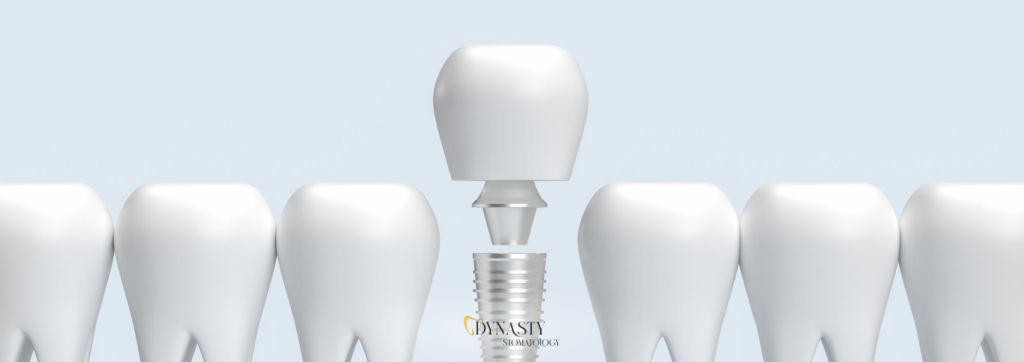
All-on-6 is a fixed full-arch restoration supported by six implants. An implant is a small component placed in the bone that replaces a tooth root. A prosthesis is attached to the implants with screws by the dentist, rather than being a removable restoration that the patient takes out themselves.
The method is considered for people with complete tooth loss, significant tooth loss, or severely damaged teeth that are qualified for extraction. Its purpose is to restore the stability of the restoration, chewing function, and smile aesthetics.
A temporary prosthesis should be distinguished from the final restoration. The former is used during healing and adaptation, while the final restoration is planned after follow-up appointments and an assessment of clinical conditions.
| Element | Simple explanation |
|---|---|
| Implant | An artificial root placed in the bone |
| Temporary prosthesis | A restoration used during the healing stage |
| Final restoration | The definitive restoration made after the temporary stage is complete |
Implant-supported teeth in one day
In selected cases, a temporary All-on-4 or All-on-6 prosthesis may be fitted immediately after the procedure. However, this does not mean that the entire treatment is completed in one day.
The possibility of immediate loading of the implants is decided by the dentist after assessing their stability, bone quality, tissue condition, and the overall treatment plan. The patient then attends follow-up visits, and the final restoration is made after the healing period.
All-on-X implantation: a unified approach to tooth restoration
All-on-X is the name for a group of solutions in which an entire full-arch prosthesis is supported by four or six implants. The letter “X” means that the number of implants is selected according to the individual patient’s conditions.
A restoration on 4 supports and All-on-6 have the same goal: restoring a full smile and the function of the entire dental arch. A higher number of implants does not always mean a better solution. The choice of method depends on diagnostic findings, not merely on the name of the procedure.
Who is All-on-6 suitable for?
All-on-6 may be considered for people who have lost all teeth in one arch, have extensive tooth loss, or cannot function comfortably with a removable denture. Treatment may also be planned when the remaining teeth are severely damaged and the dentist determines that there is no basis for preserving them in the long term.
A fixed implant-supported prosthesis can improve stability when eating and speaking. However, not every patient qualifies for the same treatment plan. The final decision depends on the examination, imaging, overall health condition, and the possibility of achieving safe implant stability.
What does qualification for treatment involve?
A consultation is not only intended to determine the price. The dentist takes a medical history, assesses the teeth, gums, and bite, and then analyses imaging, most often a CT scan.
Bone conditions, the presence of inflammation, and the possibility of placing implants securely are assessed, among other factors. After qualification, the patient receives a proposed treatment plan, schedule, and individual cost estimate.
Contraindications and situations requiring preparation
Active inflammation in the mouth, uncontrolled general health conditions, difficulties maintaining oral hygiene, or smoking may require prior treatment or changes to the plan. These are not automatically insurmountable obstacles, but they require an individual assessment by the dentist.
Treatment safety also depends on following recommendations before and after the procedure. In the case of chronic conditions, it is worth preparing an up-to-date list of medications and information from the treating physician.
What does All-on-6 treatment look like step by step?
All-on-6 treatment is a process divided into stages. Some patients may receive a temporary restoration on the day of surgery, but healing and fabrication of the final restoration require later follow-up appointments.
- Consultation and diagnostics – examination, CT scan, and discussion of expectations.
- Treatment plan – determining the number of implants, any necessary extractions, and the type of restoration.
- Oral preparation – treatment of inflammation, professional cleaning, or other procedures indicated by the dentist.
- Implant procedure – placement of implants in planned positions.
- Temporary restoration – if clinical conditions allow for its safe attachment.
- Follow-up and healing – assessment of tissues, hygiene, and adaptation to the new restoration.
- Final restoration – fabrication of the definitive construction according to the prosthetic plan.
The duration of individual stages depends on healing, bone quality, the need for additional procedures, and the body’s response to treatment.
Implant procedure and temporary restoration
During the surgical procedure, the dentist places the implants in the bone. If the earlier plan includes tooth removal, it may be performed during the same stage or separately, depending on the clinical situation.
When the implants achieve adequate stability, it may be possible to attach a temporary restoration. This decision is not automatic and always belongs to the treating dentist.
Healing and fabrication of the final restoration
After the procedure, the healing period and adaptation to the new restoration begin. The patient receives recommendations regarding hygiene, diet, and follow-up appointment dates.
The final restoration is made after healing and bite function have been assessed. The material and construction of the restoration are discussed individually, taking into account conditions in the mouth, aesthetics, and how the prosthesis will be used.
All-on-6 or All-on-4 – the most important differences
Both methods belong to All-on-X solutions and can restore a full dental arch. They differ in the number of implants and the plan for positioning support. They should not be chosen based on price alone.
| Criterion | All-on-4 | All-on-6 |
|---|---|---|
| Number of implants | Four | Six |
| Treatment goal | Full-arch restoration | Full-arch restoration |
| Surgical plan | Selected according to anatomy and bone quality | Selected according to anatomy and bone quality |
| Distribution of support | Four points of support | Six points of support |
| Cost | Depends on the scope of treatment and restoration | Depends on the scope of treatment and restoration |
| Choice of method | After diagnostic assessment | After diagnostic assessment |
In the described 4-implant restoration variant in the lower jaw, two implants are placed vertically in the front section and the other two at an angle in the back section. This positioning is part of surgical planning, not a universal approach for every patient.
All-on-6 uses six implants, but the number alone does not determine the superiority of the method. The dentist considers the quantity and quality of bone, bite, anatomical conditions, health status, and predictability of the entire restoration. The appropriate solution is selected after diagnostic assessment, not according to the number of implants alone.
Benefits, limitations, and care of All-on-6 implants
All-on-6 can provide a stable, screw-retained full-arch restoration, improve comfort in everyday life, and make chewing easier compared with an unstable removable denture. For many patients, aesthetics and not having to remove the prosthesis themselves are also important.
However, treatment requires surgery, proper qualification, a healing period, and a planned budget. The long-term result is not a lifetime promise—it depends, among other things, on hygiene, follow-up care, gum health, bite forces, and the patient’s overall health.
After treatment, you should:
- brush the restoration according to the team’s instructions,
- clean the spaces around the implants using appropriate accessories,
- attend follow-up appointments and professional hygiene visits,
- not ignore bleeding gums, discomfort, or loosening of the restoration.
The principles of long-term care for implants and the tissues around them are described in educational materials from the European Federation of Periodontology.[^1]
All-on-6 consultation, financing, and next steps
The first step is an implant consultation at Dynasty Stomatology in Krakow. The clinic provides implant treatment, including full-arch restorations using the All-on-X method (on 4 or 6 implants), and imaging diagnostics can be arranged on site.
It is worth bringing existing dental documentation, a list of medications being taken, information about chronic conditions, and previous X-rays or CT scans if they are current. The dentist will assess the clinical situation, explain possible options, discuss the necessary preparation, and provide an individual cost estimate.
Implant treatment is often paid for privately. It is worth asking about the possibility of instalment payments through MediPay, MediRaty, or an internal payment plan, if available for the particular treatment plan. Financing terms are determined individually. Reimbursement rules and the scope of private insurance should also be confirmed directly with the insurer or payer.
Dynasty Stomatology provides care in Polish, English, Ukrainian, and Russian, which may help patients from outside Poland go through diagnostics and treatment with confidence. The exact cost of new teeth on implants can only be determined after an examination—a consultation makes it possible to obtain a plan tailored to the patient’s health, needs, and budget.
[^1]: European Federation of Periodontology, patient materials on gum health and the tissues around implants: https://www.efp.org/