



Dental crowns (ceramic) offer protection to damaged, or decayed teeth. These crowns, used for various dental procedures are made from safe, bio-compatible and metal-free materials like porcelain, resin, and zirconia for front teeth.


Bite anomalies

Short crown

Inflammation of the gums
What is an all-ceramic dental crown?
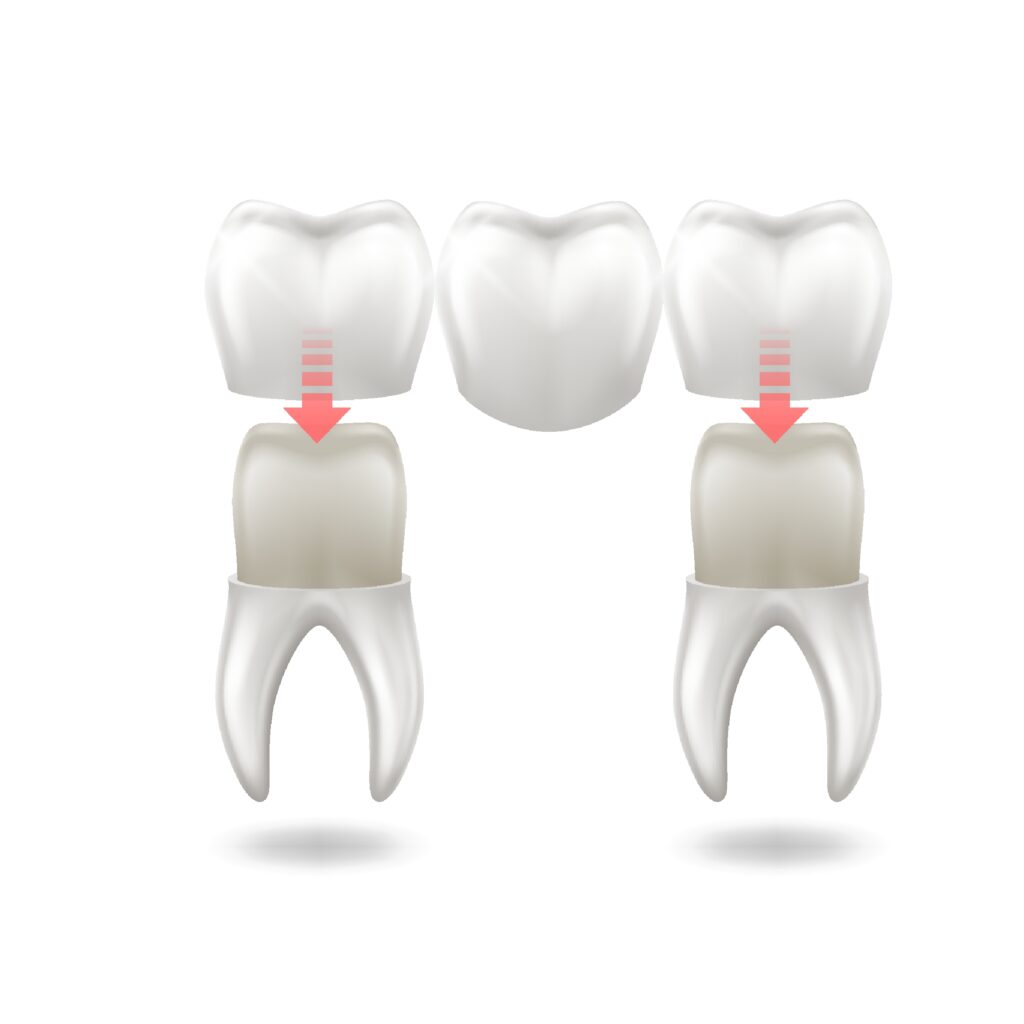
An all-ceramic crown protects weak or damaged teeth from potential decay, stains, or harm. It looks like a natural tooth-shaped cap and customized in size to fit the patient’s mouth. The crown is placed on the top of the affected tooth and functions like a natural tooth.
Unlike metal crowns, it does not cause irritation and is perfect for people with metal allergies or other mouth or bone sensitivities. The crown is designed in such a way that it merges organically with the surrounding teeth enhancing smile aesthetics and your bite functionality. Crowns may be recommended for adults and children by a skilled dentist.
All-ceramic dental crowns price in Krakow
-
Prosthodontic consultation
250 PLN -
Tomography of 1 jaw
250 PLN -
Tomography of 2 jaws
350 PLN -
Zirconia implant crown
3 300 PLN -
Zirconia crown
2 500 PLN -
E-max crown
2 800 PLN -
Zirconia crown on a baby tooth
400‑700 PLN
How the Dynasty Stomatology dental clinic's loyalty program works
Learn more about the loyalty program
Step 01
Visit the clinic and scan the QR code at the reception desk
Step 02
Register online — enter your details
Step 03
Receive and accumulate points after each visit
Do you want to restore the beauty of your smile with dental crowns (ceramic)?
Make an appointment!
By clicking the button, you agree to the processing of personal data in accordance with the privacy policy.
Frequently asked questions about dental crowns
-
Yes, fillings have the disadvantage of staining front teeth. Veneers can resist them and retain their color longer.
-
The indications for the execution of crowns are cracked, damaged, decayed or worn-out teeth. They are recommended after a root canal treatment.
-
Full ceramic crowns last for 10-15 years. They are also dependent on the tooth bite pressure, dental habits and overall oral hygiene.
-
It takes 1-3 days to fit a prosthetic crown on a dental implant depending upon the bone health and gum quality.
-
The choice between fixed or removal restoration depends upon personal preference, comfort, and oral health care habits.
-
Yes, ceramic dental crowns are an excellent choice for many patients. They closely mimic the natural appearance of your teeth in terms of color, translucency, and shape, making them especially popular for front teeth. Ceramic crowns are also biocompatible, meaning they are well-tolerated by your body and unlikely to cause allergic reactions. With proper care and good oral hygiene, high-quality ceramic crowns can last 10–15 years or even longer.
-
Ceramic crowns typically last between 10 and 15 years, and with excellent oral hygiene and regular dental check-ups, many patients enjoy them for 20 years or even longer. Their longevity depends on factors such as your oral care habits, bite forces, and avoiding habits like teeth grinding or chewing on hard objects. At our clinic, we use high-quality ceramic materials and precise techniques to help ensure your crown serves you well for as long as possible.
-
The cost of a dental crown in Poland typically ranges from 800 to 2,500 PLN (approximately €180–€560), depending on the material used. Porcelain-fused-to-metal crowns are the most affordable option, while all-ceramic or zirconia crowns are at the higher end due to their superior aesthetics and durability. For an exact quote tailored to your needs, we invite you to schedule a consultation at our clinic — we'll be happy to discuss the best option for your smile and budget.
-
Ceramic crowns, while highly aesthetic, do have a few drawbacks to consider. They are generally less resistant to heavy biting forces compared to metal or zirconia crowns, which means they may chip or fracture — especially on back teeth where chewing pressure is greatest. They also tend to be more expensive than traditional metal-based crowns. However, with proper care and regular check-ups, ceramic crowns can last many years — and at our clinic, we'll help you choose the best option for your individual needs and lifestyle.
-
Most often, at least two appointments are required: tooth preparation and taking a scan, followed by a try-in and placement of the finished crown. When root canal treatment, tooth rebuilding, or implant treatment is needed, the plan includes additional stages.
-
No, the procedure to prepare a tooth for a crown is usually performed under local anaesthesia, so the patient should not feel pain. Temporary sensitivity is possible after the appointment. If severe or persistent pain occurs, contact your dentist.
Doctors who perform ceramic crown placement
View all doctors
Vladyslav Karkachov
General dentist, endodontist, prosthodontist
Relies on a well-thought-out treatment plan and good rapport with the patient. A friendly approach helps build trust, even among those afraid of de...

Borys Minakov
Prosthodontist
His approach focuses on individually tailored treatment plans that not only solve current issues but also prevent future ones. This helps patients ...

Dmytro Ostrovskyi
Prosthodontist
Over 30 hands-on courses completed in 9 years of practice. A comprehensive approach guarantees stable, durable, and predictable results.
Reviews on ceramic dental crowns in Krakow
Expert articles on the topic
View all blog-
19.08.2026
2
10 min. read
What to choose veneers or crowns – which solution will be better for you?
Veneers or Crowns: The Key Difference A veneer mainly covers the visible front surface of a tooth and is primarily…
Read more -
21.01.2026
506
6 min. read
The Best Dental Restoration Options for Damaged Teeth
When something happens to a tooth, the first reaction is often anxiety. People often assume that treatment will be expensive…
Read more -
06.01.2026
490
8 min. read
Dental Prosthetics – The Secret to a Beautiful Smile
A healthy smile isn’t just about looking perfect. It’s about how comfortable you are when you eat, how freely you speak, and how confident you feel when you smile. After all, if you have chips, cracks, or missing teeth, your lifestyle changes. That’s why dental prosthetics plays a crucial role in restoring your sense of […]
Read more -
09.12.2025
1295
5 min. read
What is Dental Splinting and How It Can Save a Loose Tooth?
Loose teeth in adults are often a sign that something important is changing in your mouth. This causes a lot…
Read more -
31.07.2025
1868
6 min. read
What is Inlay, Onlay and Overlay in dental restoration – pros & cons, purpose and cost
In modern dentistry, there are several advanced options for restoring damaged teeth with precision and durability. Inlay, onlay, and overlay…
Read more -
24.07.2025
1101
10 min. read
Dental Crowns: Types, Costs, and the Procedure
Dental crowns play a vital role in restoring the strength, function, and appearance of damaged or weakened teeth. Whether due…
Read more






Dental Crowns Krakow – Durable Smile Restoration Tailored to You
A dental crown is a fixed restoration that recreates the shape, function, and appearance of a damaged tooth. It is placed on a properly prepared natural tooth or on an implant when the tooth is missing. A well-planned crown allows you to bite, speak, and smile comfortably without feeling that the restoration looks artificial.
A crown is primarily used when too little healthy tooth tissue remains to safely support a large filling. Common indications include extensive cavities, a tooth after root canal treatment, a crack in the enamel or a tooth cusp, old leaking fillings, and the need to improve the colour or shape of an individual tooth.
At Dynasty Stomatology in Krakow, the treatment plan begins with an examination of the teeth, gums, and bite—that is, the way the upper and lower teeth meet. Thanks to on-site digital diagnostics, the dentist can assess whether a crown will be the appropriate restoration or whether cavities, root canals, or gum inflammation need to be treated first.
When is a crown a better option than a large filling?
A large filling restores the missing part of a tooth, but it does not always protect its thin, weakened walls. When the defect covers a significant part of the chewing surface or side walls, the tooth may crack while biting. A crown covers it from the outside and distributes chewing forces over a larger area.
The dentist considers the amount of remaining tooth structure, the depth of the previous defect, teeth grinding, and bite contacts. For example, after extensive root canal treatment, a composite restoration may be insufficient if the clinical crown of the tooth is severely damaged. The final decision is made after an examination and diagnostic imaging.
A crown on an implant versus a crown on a natural tooth
A crown on a natural tooth uses the remaining root and tooth tissues as support. First, the dentist reinforces and prepares the tooth, then creates a prosthetic restoration fitted to the bite.
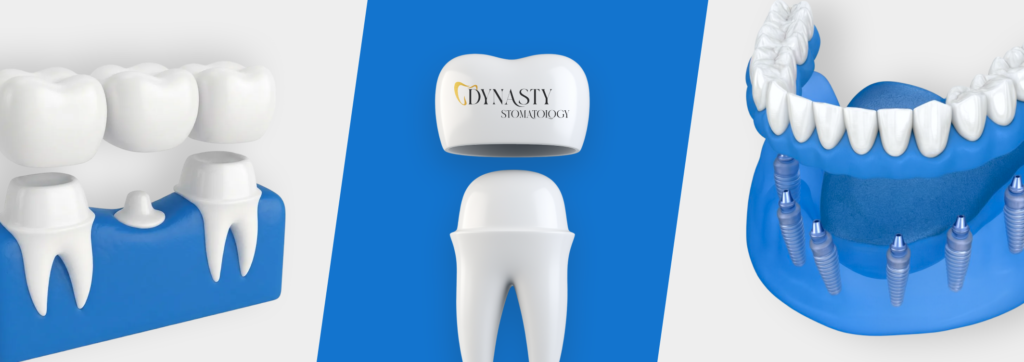
A crown on an implant replaces a missing tooth. An implant—a titanium or other biocompatible fixture placed in the bone—replaces the root, while the crown recreates the part visible in the mouth. This is a different treatment that requires an assessment of the bone, gums, and overall health. The choice is not about identifying the “better” method, but about finding a safe solution for the specific situation.
Types of dental crowns – how to choose the right material?
The crown material affects its appearance, resistance to chewing forces, and how the restoration works with neighbouring teeth. In the visible smile zone, colour, translucency, and natural light reflection are particularly important. In back teeth, resistance to heavy loads matters more.
| Material / crown type | Aesthetics | Typical use | Advantages | What to discuss during the consultation |
|---|---|---|---|---|
| All-ceramic | Very natural, with no metal substructure | Most often front teeth, sometimes back teeth | Precise matching of colour and translucency | Bite conditions, available space, habit of clenching teeth |
| Ceramic on a substructure | Good aesthetics, depending on the design | Front and back teeth | A combination of aesthetics and structural strength | Gumline visibility, chewing forces, extent of tooth preparation |
| Ceramic-veneered | Ceramic covers the outer portion | Selected prosthetic restorations | Aesthetic finish of the visible surface | Risk of veneer chipping and bite conditions |
The term “porcelain crowns” is often used by patients to refer to crowns with a ceramic layer. However, it is worth asking the dentist about the exact design of the proposed restoration rather than relying solely on the material name. At our Krakow clinic, we also match the shade and surface character of the crown to the patient’s age, neighbouring teeth, and overall smile.
All-ceramic crowns – aesthetics close to natural teeth
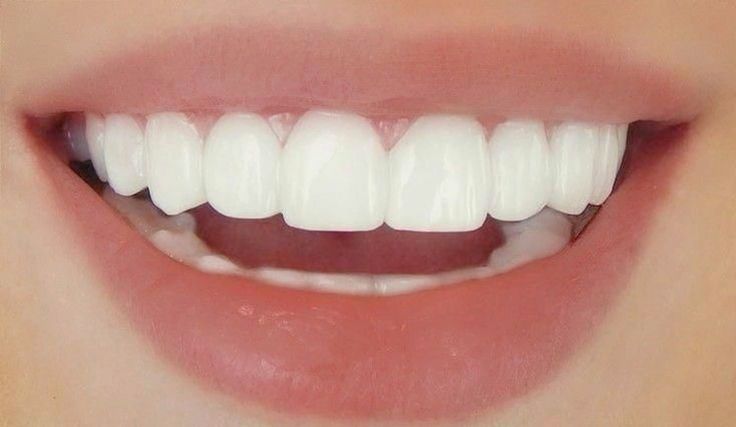
All-ceramic crowns have no metal substructure, so light passes through them in a way that is closer to natural enamel. The dentist can match not only the base shade, but also translucency at the incisal edge, subtle colour differences, and surface texture.
For this reason, all-ceramic crowns are a frequent choice in the smile zone, especially when restoring a central incisor, lateral incisor, or canine. A natural effect does not automatically mean a very bright colour, however. The crown should blend with the remaining teeth rather than stand out as a separate element.
Ceramic and porcelain crowns – who are they suitable for?
A ceramic crown is a broader term for a restoration made of ceramic materials or covered with ceramic. “Porcelain” is a common term that patients often use for aesthetic crowns veneered with ceramic. Differences in design matter for durability, aesthetics, and the extent of tooth preparation.
When making a choice, the dentist analyses the tooth’s location, smile width, gum condition, bite, and possible bruxism—that is, habitual grinding or clenching of the teeth. If you are interested in porcelain crowns in Krakow, ask during your appointment to discuss specific options, their indications, and the cost of the full treatment.
How can the colour and shape of a crown be matched to your smile?
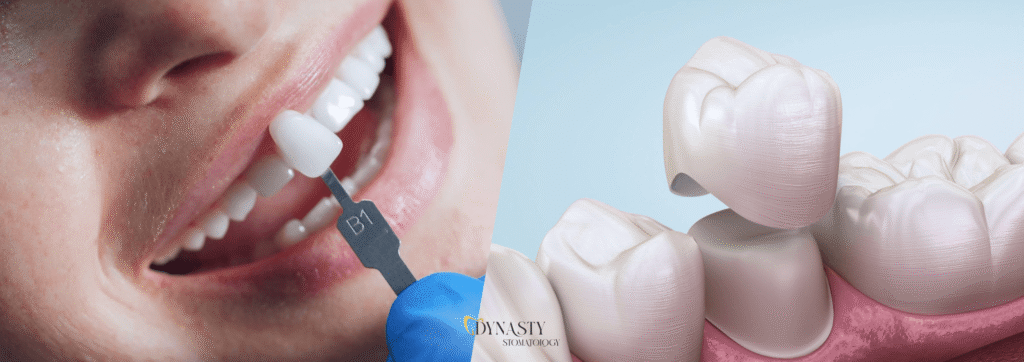
Crown selection begins with observing the neighbouring teeth. Their colour, length, width, translucency, position, and gumline are assessed. The smile line and the way the teeth contact during speaking and chewing also matter.
The patient should say whether they want a subtle recreation of their current appearance or a correction of the tooth shape. The dental technician works from a scan or impression and information provided by the dentist. The lightest shade does not always look best—an authentic result usually comes from matching the entire dentition well.
What is the process of getting a dental crown?
The process of getting dental crowns takes place in stages and usually requires more than one appointment. First, we determine whether the tooth is ready for restoration. Then we prepare it or plan implant treatment, take an intraoral scan or impression, and check the completed restoration before final placement.
- Consultation and diagnostics – oral examination, bite assessment, and X-rays or CT scans if needed.
- Preparation for restoration – treatment of the tooth, rebuilding its core, or preparing the implant.
- Scanning or impression – transferring data to the dental laboratory.
- Crown fabrication and try-in – checking the colour, contacts with neighbouring teeth, and bite.
- Placement and check-up – cementing the crown onto the tooth or screwing in or fitting the restoration on the implant, depending on the treatment plan.
Treatment time depends on the initial condition. A simple restoration of one tooth proceeds differently from treatment preceded by endodontics, meaning root canal treatment, or an implant stage.
Consultation and diagnostics before crown placement
During the first appointment, the dentist checks whether the tooth has sufficient support, whether there are inflammatory changes around the root, and whether the gums are healthy. They also assess the bite. Even a beautifully made crown will not be comfortable if it is overloaded because of incorrect tooth contacts.
Sometimes, before prosthetic treatment, it is necessary to remove decay, replace a leaking filling, carry out root canal treatment, or provide periodontal treatment for the gums and tissues supporting the tooth. Digital diagnostics available on site, including X-rays, CT scans, and 3D scans, help plan the restoration based on the actual image of the tooth.
Try-in, cementation, and recommendations after crown placement
Before placement, the dentist checks whether the crown fits precisely, does not press on the gum, and has proper contacts with neighbouring teeth. The patient bites down several times to assess the height of the restoration. This is an important moment, because even a slight feeling that the tooth is “too high” should be reported immediately.
After cementation, there may be a short adjustment period to the new shape. Daily hygiene remains essential: brushing twice a day and cleaning between the teeth. If persistent discomfort, pain when biting, crown movement, or gum bleeding occurs, contact the clinic rather than waiting for the next routine check-up.
How much do dental crowns cost in Krakow?
The price of a crown is not simply the price of the prosthetic restoration. The cost is affected by the material, the number of teeth being restored, the scope of diagnostics, tooth preparation, and any treatment required beforehand. Therefore, a reliable dental crown price list should separate the cost of the crown itself from the procedures needed to place it securely and safely.
Before treatment begins, the patient should receive a plan detailing the stages. At Dynasty Stomatology, we focus on a transparent discussion of options so that you can compare solutions and plan your budget. Available instalment payment options include MediPay, MediRaty, and an internal payment plan, the terms of which are agreed individually.
| Pricing element | Why it affects the cost |
|---|---|
| Type of crown | Different materials and designs require different fabrication technologies |
| Tooth condition | The tooth may require rebuilding, root canal treatment, or a reinforcing post |
| Crown on an implant | The estimate includes separate prosthetic components and earlier treatment stages |
| Diagnostics | X-rays, CT scans, or 3D scans are selected according to indications |
| Number of crowns | A plan for a single tooth differs from restoring a larger section |
What affects the price of a dental crown?
It is worth coming to the consultation with specific questions: what material does the dentist recommend, what does the quoted amount include, does the tooth require reinforcement, and which examinations are necessary? With a larger treatment plan, it is also a good idea to ask whether the next stages can be spread out over time without harming dental health.
The cost of dental crowns increases when the restoration requires prior root canal treatment, a post-and-core restoration, or gum treatment. A crown on a natural tooth is also priced differently from a restoration on an implant. The fairest answer is an individual cost estimate after an examination, not a general amount found online.
NFZ crowns and private treatment – what is worth checking?
The scope of services funded by the National Health Fund (NFZ) and eligibility rules may change and are limited by specific regulations. You should not assume either full reimbursement or a complete lack of reimbursement without checking the current situation.
Before your appointment, ask the reception desk whether the particular service is available under the NFZ, what the eligibility requirements are, and what the expected timeframe is. For private treatment, it is worth obtaining information about the price of the consultation, diagnostics, crown, and any additional procedures.
Crown or dental bridge – which option should you choose for missing teeth?
A single crown restores a tooth that still has a retained root or replaces a missing tooth on an implant. A dental bridge has a different purpose: it fills the gap left by a lost tooth by being supported by the teeth next to it. It consists of crowns on the supporting teeth and a pontic, which is an artificial tooth in the missing space.
When making a choice, we analyse the condition of neighbouring teeth, the number of missing teeth, bone conditions, hygiene, and bite. If the teeth on both sides of the gap are already severely damaged and require crowns, a bridge may be a reasonable part of the plan. If they are healthy, the dentist also discusses the option of an implant-supported crown, which does not require grinding down the adjacent teeth.
How should you care for crowns and dental bridges?
A crown cannot develop decay, but the tooth at its margin and the surrounding gum can still become diseased. That is why thorough brushing with fluoride toothpaste, daily cleaning between the teeth, and regular hygiene appointments are essential.
With a bridge, the space beneath the pontic requires special attention. Properly selected interdental brushes, bridge floss, or a water flosser can be helpful, but the choice of tool should take the shape of the restoration and gum condition into account. Do not use your teeth to open packaging or bite very hard objects. If you clench your teeth at night, the dentist may recommend a protective night guard.
Prosthetic consultation in Krakow – how to book an appointment?
When booking, tell us which tooth requires restoration, whether you have pain, whether the tooth has had root canal treatment, and whether you have current X-rays. It is also worth mentioning if you require service in Polish, Ukrainian, Russian, or English. Dynasty Stomatology sees patients at ul. Romanowicza 1/LU3 and ul. Romanowicza 4B in Krakow.
At your first visit, you will receive an assessment of the situation, information about diagnostics, and an initial plan for further treatment. A practical tip: before the appointment, write down three priorities, such as durability, a natural appearance, and budget. This will make it easier to discuss the material and treatment stages. Reception: +48 576 676 266, during clinic opening hours from Monday to Friday, 8:00 a.m.–8:00 p.m., and on Saturdays, 8:00 a.m.–2:00 p.m.