



Many parents mistakenly believe that it is not necessary to treat decayed baby teeth, because they will soon fall out and be replaced by permanent teeth. However, damage to temporary teeth can lead to pain, inflammation, bite disorders and improper formation of permanent dental units. Timely contact with the doctor helps to avoid serious complications and preserve the health of the child's oral cavity.

Treatment for early childhood caries

Silvering
Remineralization

Ozone therapy
Symptoms of deep decay in baby teeth
Initial decay of baby teeth often goes unnoticed – it can manifest itself only as a small white spot on the enamel, without pain and other obvious signs. But because of the thin enamel structure, the pathological process quickly progresses, passing first to medium caries, and then to the deep stage, requiring urgent treatment.
Signs of deep caries in a child:
- visible defects and destruction in the tooth surface;
- darkening of enamel and formation of deep cavities;
- softening of dentin (inner layer of the tooth);
- acute reaction when touching the affected part of the tooth with a dental instrument, reaction to cold, hot, spicy, salty;
- bad breath;
- difficulty in chewing and refusal to eat;
- general deterioration of the child’s health, lethargy;
- restless sleep, frequent awakenings due to pain.
When caries develops and its symptoms appear, it is important to see a pediatric dentist as soon as possible.
Treatment for early childhood caries - Prices in Krakow
-
Composite filling of a baby tooth
300‑400 PLN
How the Dynasty Stomatology dental clinic's loyalty program works
Learn more about the loyalty program
Step 01
Visit the clinic and scan the QR code at the reception desk
Step 02
Register online — enter your details
Step 03
Receive and accumulate points after each visit
Do you want to treat your teeth while you sleep?
Schedule an appointment!
By clicking the button, you give your agreet your personal data in accordance with privacy policy.
Frequently asked questions about treating cavities in baby teeth
-
Baby teeth are important for proper bite formation, speech development, chewing, and maintaining space for permanent teeth. In addition, untreated decay can lead to complications (periodontitis, pulpitis, etc.) and affect the health of the entire body.
-
Premature extraction of a baby tooth can cause displacement of neighboring teeth, bite problems, and make it difficult for permanent teeth to erupt.
-
There are initial (white spots), superficial, medium and deep caries. The deeper the lesion, the more difficult it is to treat.
-
Stains on the enamel, darkening of the teeth, complaints of pain when eating, poor sleep, bad breath, restlessness of the child - all this is a reason to immediately contact a dentist. Otherwise, complications may develop and pulpitis treatment or tooth extraction may be required.
-
Yes, especially with young children. The presence of a parent helps the child to feel more relaxed, and the doctor to establish a rapport and explain the course of treatment.
-
Decayed baby teeth are treated depending on the extent of the damage. For small cavities, we use gentle fillings, while more advanced decay may require pulp treatment (cleaning the inside of the tooth) followed by a protective crown. In the most severe cases, extraction may be necessary. We always prioritize saving the tooth whenever possible, as baby teeth play an important role in guiding permanent teeth into the correct position. Our team ensures your little one feels safe and comfortable throughout the entire procedure.
-
Yes, in many cases a decayed baby tooth can be saved, and it's important to try! Depending on the extent of the decay, we can treat it with a filling, a pediatric crown, or even a pulpotomy (a gentle procedure to treat the tooth's nerve). Saving baby teeth is essential because they hold space for the permanent teeth and support your child's proper chewing, speech development, and jaw growth. The sooner decay is detected, the easier and more comfortable the treatment, so don't hesitate to bring your child in for a check-up.
-
Yes, tooth decay can affect children as young as 2 years old — and even earlier, as soon as the first teeth appear. This condition, often called early childhood caries, is commonly caused by prolonged exposure to sugary drinks, milk left on the teeth (especially from nighttime bottle feeding), and insufficient oral hygiene. We recommend scheduling your child's first dental visit by their first birthday and gently cleaning their teeth twice daily as soon as they emerge. If you notice white spots, discoloration, or dark areas on your toddler's teeth, please bring them in for a check-up as early treatment can prevent further damage.
Pediatric dentists treating cavities in baby teeth
View all doctors
Yuliia Rudzynska
Pediatric dentist
Helps children not only maintain healthy teeth but also develop a positive attitude toward dentistry, ensuring fear-free visits.
Reviews of baby teeth cavity treatment in Krakow
Expert articles on the topic
View all blog-
17.09.2026
5
8 min. read
Teeth Grinding in Children – What Every Parent Should Know
For parents who hear grinding at night or notice that their child complains of jaw tension in the morning, the most important thing is to assess the situation calmly. Not every episode indicates a problem requiring treatment, but recurring symptoms should be discussed with a pediatric dentist. What Is Bruxism in Children, and Does It […]
Read more -
11.09.2026
4
9 min. read
Malocclusion in Children: Types, Symptoms, and Treatment Methods
A child’s malocclusion may involve the alignment of the teeth, the relationship between the dental arches, and the position of the upper and lower jaws in relation to each other. Not every irregularity requires immediate treatment, but early assessment helps determine whether monitoring or orthodontic treatment is needed. What Is Malocclusion in Children and When […]
Read more -
07.07.2026
270
10 min. read
Deciduous Tooth Decay in Children – Methods for Treating Cavities
Many parents believe that cavities in baby teeth are nothing to worry about. After all, they'll fall out anyway, so…
Read more -
15.04.2026
355
10 min. read
How to Take Care of Your Child’s Teeth – Healthy Teeth Tips
Every parent has experienced this moment at least once: when their child turns away, purses their lips, and flatly refuses…
Read more -
01.04.2026
378
9 min. read
Dentophobia — How to Overcome the Fear of the Dentist in Children and Adults?
Dentophobia — How to Overcome the Fear of the Dentist in Children and Adults? Sometimes, fear of the dentist doesn't…
Read more


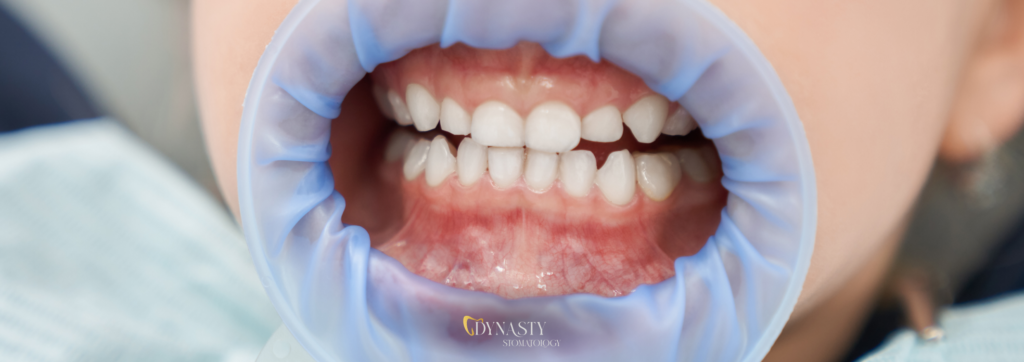


To undergo treatment for early childhood caries without stress and pain, contact Dynasty Stomatology in Poland. We will gently and professionally help even the youngest patients, using gentle methods and modern materials.
Treatment for early childhood caries – Causes of tooth decay in children
Caries develops rapidly on baby teeth – much faster than in adults due to the enamel structure and lifestyle. It is important to understand what factors can provoke its appearance in order to prevent tooth decay in time.
The main causes of dental caries in babies are:
- poor or insufficient oral hygiene;
- habit of drinking milk or juice from a bottle before bedtime;
- abuse of sweets and carbonated drinks;
- congenital enamel anomalies, hereditary predisposition;
- deficiency of fluoride, calcium, vitamins in the diet;
- eating disorders;
- weakened immunity, frequent infections;
- improper teething and crowding, which does not allow to brush teeth thoroughly.
The causes of caries, as a rule, lie in the accumulation of dental plaque, in which bacteria multiply, gradually provoking the weakening of tooth enamel, and then the formation of a cavity.
Treatment for early childhood caries – Consequences of decayed baby teeth
If you do not treat baby tooth decay in time, it can lead to serious complications not only in the oral cavity, but also in the overall development of the child. Tooth decay disrupts the chewing process, which affects digestion and can provoke nutrient deficiencies. In addition, infection from it can easily spread to neighboring teeth, including the rudiments of permanent dental units, causing damage to them even before they erupt.
Also, early loss of baby teeth due to tooth decay contributes to the formation of an incorrect bite and distortion of the tooth row, because the early removal of a diseased tooth disrupts the natural order of growth. In addition, neglected caries is accompanied by constant pain, inflammation, bad breath and speech problems, which negatively affect the psycho-emotional state of the child. Therefore, treatment is an obligatory step towards a healthy childhood and proper development.
Methods of treatment for early childhood caries in Krakow
Treatment of dental caries in children should be started as early as possible. It is aimed at eliminating the focus of infection, eliminating the destroyed tooth tissue, restoring the form and function, as well as preventing complications and preserving the tooth until its natural replacement. The method is always selected individually, taking into account the type of caries, the age of the child, the degree of destruction of the tooth, the peculiarities of the bite and behavior of the young patient.
The main methods of treatment for early childhood caries:
- Filling – an effective way to treat permanent and temporary tooth decay, involves removing the affected tissue and restoring its shape with composite materials.
- Dephophoresis – treatment of roots with electric current with the introduction of antiseptic in case of complicated caries.
- Preparation – a classic method of removing damaged tissue with the help of a drill and the subsequent installation of a filling.
Our doctors try to avoid extracting a baby tooth if there is even the slightest chance of saving it. To make the procedure painless, we use anesthesia and also offer treatment in your sleep. In extreme cases, it is possible to treat teeth under general anesthesia.
Features of treatment for early childhood caries at Dynasty Stomatology
Milk tooth decay treatment in our clinic is performed with special attention to the comfort and psychological state of a young patient. We realize that a visit to the dentist can be stressful, so we do everything we can to make the adaptation soft and painless:
- Comfortable anesthesia. Our doctors use modern, gentle methods of anesthesia – both application gels and local anesthetics with minimal discomfort when administered.
- Individual approach to the duration of the appointment. We take into account the age and behavioral characteristics of each child. If necessary, we take short breaks so that the patient does not get tired.
- Fast work with modern materials. To reduce the time of dental treatment and stay in the chair, we use filling materials that harden quickly and do not require additional procedures.
- Use of sedation. In particularly difficult cases (including those with high sensitivity and failure to cooperate), sedation – gentle sedation – is possible, allowing the procedure to be performed safely and without fear.
The entire Dynasty Stomatology team cares not only about dental health, but also about your child’s trust in the dentist from an early age. Our treatment is tearless!
Treatment for childhood caries – Stages of caries treatment
Treatment of decayed teeth in our clinic takes place in stages and is as gentle as possible. Each step is aimed at eliminating caries, restoring the tooth taking into account the anatomical and age features of the child, as well as preserving the rudiment of a permanent tooth. main stages:
- Consultation and Diagnosis. The doctor performs an examination of the oral cavity, if necessary, prescribes x-rays, assesses the degree of tooth lesions.
- Anesthesia and isolation of the tooth from saliva to maintain sterility.
- Removal of decayed tissue using safe instruments.
- Restoring the tooth with a filling using quality materials that preserve function until it naturally changes from baby teeth to permanent teeth.
Milk tooth decay treatment – How to prevent tooth decay in baby teeth
At Dynasty Stomatology, we utilize state-of-the-art methods to prevent milk tooth decay:
- professional cleaning to remove plaque;
- fissure sealing to fill the natural grooves on chewing teeth;
- fluoridation to strengthen enamel;
- balanced diet – limiting sweets, carbonated drinks and unhealthy snacks;
- home hygiene – the doctor will tell you how to brush your teeth correctly, it should be done 2 times a day with age-appropriate pastes.
Regular preventive visits to the dentist can help you avoid complicated treatment and keep your teeth healthy for a long time.
Milk tooth decay treatment – Prices at Dynasty Stomatology
Our pediatric dentistry offers a loyal cost of treatment of decayed baby teeth. However, the final price depends on the stage of the lesion, the amount of necessary procedures and selected materials. We offer a transparent price and use effective methods in dental treatment.
Make an appointment today – take care of your child’s smile together with professionals!