

Orthognathic surgery helps to solve problems with the bite that cannot be treated with braces or aligners. If you have difficulty chewing, speech disorders or are unhappy with the shape of your face, surgical correction may be the best solution.

Orthognathic surgery in Krakow – surgical correction of malocclusion

Mesial bite

Distal bite

Deep bite
Stages of treatment with orthognathic surgery
The process of bite correction in combination with orthognathic surgery includes several stages:
- Orthodontic consultation. The orthodontist performs an initial examination, collects anamnesis and selects a comprehensive treatment.
- Orthodontic diagnostics. Images (X-ray, CT), impressions, photo protocol, and analysis of bite defects are taken.
- Sending data to the maxillofacial surgeon. Diagnostic materials are transferred to a specialist for planning the intervention.
- Personal consultation with a maxillofacial surgeon. Discussion of possible scenarios of the operation, expectations and risks.
- Installation of braces. Alignment of teeth and preparation for surgery to ensure proper closure of the dental arches after the procedure.
- Operation- carrying out an intervention according to a pre-prepared plan.
- Rehabilitation- recovery after surgery, monitoring tissue healing and bite.
- Orthodontic treatment details— improvement of the bite and position of the teeth after surgery (a plate or bite correction with braces can be used).
- Removal— completion of treatment and transition to the retention period.

Price: Orthognathic surgery in Krakow – surgical correction of malocclusion
All price-
Consultation + examination and treatment plan
250 PLN
Do you want to treat your teeth while you sleep?
Schedule an appointment!
By clicking the button, you give your agreet your personal data in accordance with privacy policy.
Frequently asked questions about orthognathic surgery
-
When are the results of the operation visible?
The first visible result appears immediately after the operation, but the final effect is formed several months after recovery.
-
How severe does malocclusion have to be before orthognathic surgery is considered?
The operation is indicated for significant occlusion disorders, when it is impossible to correct the bite with orthodontic treatment alone.
-
Is it possible to undergo orthognathic surgery without wearing braces first?
In most cases, preliminary orthodontic treatment is necessary to properly align the teeth before surgery.
-
How does orthognathic surgery affect facial appearance and facial expressions?
The operation improves facial proportions and harmonizes the profile, while facial expressions are preserved and usually become more natural.
-
Are there any alternatives to surgical correction of malocclusion in cases of complex forms of anomalies?
For severe deformities, surgery is the only effective method, although mild disorders can only be corrected by orthodontics.
-
Is it possible to model the result of orthognathic surgery in advance in 3D?
Yes, modern technologies allow us to accurately model and visualize the expected result of the operation in 3D.
-
Does the effect of orthognathic surgery last for life?
With proper care and adherence to recommendations, the results of the operation are long-lasting and stable.
-
What diet is recommended after surgery and at what stage can you return to your normal diet?
In the first weeks, soft and liquid foods are recommended, gradually moving to a normal diet as healing occurs.
-
Is hospitalization required after orthognathic surgery and how long does it last?
Hospitalization is usually required for 1-3 days to observe and monitor the patient's condition.
-
Is it possible to combine orthognathic surgery with other maxillofacial procedures?
Yes, often operations are combined to achieve maximum therapeutic and aesthetic effect.
-
How common are complications after orthognathic surgery and how are they resolved?
Complications are rare and are usually successfully eliminated with timely intervention by specialists.
Surgeons who perform bite-correcting orthognathic surgery
View all doctors
Anastasiia Danyliuk
General dentist, endodontist
Focuses not only on treatment effectiveness but also on patient comfort. Her main goal is to provide long-term results without the need for repeate...

Yana Tereshchenko
General dentist, endodontist
Cares about both the health and the aesthetic and functional aspects of her patients’ teeth, helping preserve a natural, beautiful smile for years.

Yuliia Rudzynska
Pediatric dentist
Helps children not only maintain healthy teeth but also develop a positive attitude toward dentistry, ensuring fear-free visits.

Borys Minakov
Prosthodontist
His approach focuses on individually tailored treatment plans that not only solve current issues but also prevent future ones. This helps patients ...
Reviews of orthognathic surgery in Krakow
Expert articles on the topic
View all blog-
24.02.2026
41
9 min. read
Understanding Oral Surgery — What You Need to Know
Until recently, a visit to the dentist was associated with significant discomfort. Uncomfortable impressions, long waits, and the need for…
Read more -
19.12.2025
121
8 min. read
Tooth root resection – when should the apicoectomy be performed?
Sometimes dental problems develop unnoticed. Everything appears normal on the outside, but inflammation can gradually develop inside, right at the root. Pain may be intermittent or absent altogether. Only a dentist can detect the problem from an X-ray. In such cases, standard root canal treatment isn’t always effective. A dentist can offer a more precise […]
Read more -
17.12.2025
149
5 min. read
Do Wisdom teeth always need to be removed – Debunking Common Myths
Wisdom teeth are the teeth that most often cause unexpected issues. Some people live with them comfortably throughout their lives, while for others, they develop into impacted teeth, causing complications. Wisdom teeth behave differently, and there’s no single answer — to remove or not to remove. A personalized approach is essential to determine whether wisdom […]
Read more -
25.11.2025
200
7 min. read
Frenulum cutting in children – when should the frenulum be cut
Many children struggle with a problem that can impact proper speech development and eating comfort – a tongue or lip frenulum that is too short or improperly attached. While this is often noticeable in infants, the problem may go unnoticed until preschool age. Lip frenulum cutting in adults may be indicated in cases of limited […]
Read more -
21.11.2025
342
8 min. read
Dry socket – one of the complications after tooth extraction
Most tooth extractions heal normally, but some patients may experience a condition known as dry socket. This painful post-extraction complication can develop when the tooth extraction clot fails to remain in the wound, leaving the socket exposed. In this situation, severe pain often occurs, which can radiate to the ear, temple, or jaw, and home […]
Read more -
23.07.2025
609
7 min. read
What to Expect After Wisdom Tooth Extraction: Recovery Tips
Wisdom tooth extraction is a common dental procedure, often necessary to prevent or resolve issues such as overcrowding, infection, or impaction. While the surgery itself is typically quick and routine, knowing what to expect during the recovery process can make a significant difference in healing smoothly and comfortably. In this article, we’ll walk you through […]
Read more
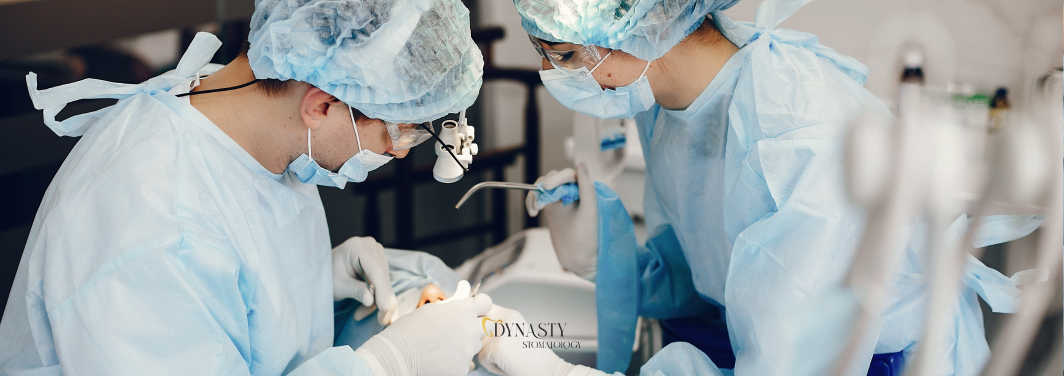





Dynasty Stomatology Clinic in Krakow offers such operations by experienced maxillofacial surgeons using modern equipment. We provide full support – from diagnostics to recovery.
What is orthognathic surgery?
Orthognathic surgery is an intervention that involves surgical correction of the bite. It is aimed at correcting the position of the upper and lower jaws relative to each other to restore the correct closure and harmonious proportions of the face.
Orthognathic operations to correct the bite are performed in cases of serious anomalies when orthodontic treatment is not enough. The intervention helps to improve not only aesthetics, but also speech, breathing and chewing functions.
Why are bite pathologies dangerous?
Malocclusion can cause constant tension in the jaw muscles, pain in the temporomandibular joint area, and headaches. Pathological occlusion also makes chewing and speech difficult and can lead to uneven tooth wear. Without correction, the situation only gets worse over time, so you should not delay visiting a doctor.
Indications for orthodontic treatment with orthognathic surgery
Malocclusion cannot always be corrected with braces or caps. In some cases, a comprehensive approach is required, including surgical intervention to correct the position of the lower and upper jaw. For example, when anomalies have a significant impact on appearance, speech, chewing or the health of the dental system.
Indications for orthognathic surgery:
- Open bite: A gap remains between the upper and lower teeth even when the jaws are completely closed, which can also interfere with chewing and speech.
Contraindications to surgical correction of malocclusion
Although bite correction surgery is safe in most cases and produces stable results, there are conditions in which it is temporarily or completely contraindicated:
- oncology;
- some blood diseases (hemophilia) and bone formation;
- severe liver and kidney dysfunction;
- decompensated pathologies of the heart and blood vessels;
- serious mental disorders;
- age under 18 years (excluding emergency indications for surgery).
Types of orthognathic surgeries
Depending on the treatment goals and the severity of occlusion disorders, orthognathic interventions are divided into several types.
By volume of intervention
Depending on the number of jaws being corrected, the following types of operations are distinguished:
- Single jaw operations — only the upper or lower jaw is affected, for example, if the bite anomalies are moderate.
- Bimaxillary operations — both jaws are adjusted simultaneously to precisely align the dental arches, restore the bite and improve facial proportions.
By area of intervention
Also, surgical orthodontic treatment methods are classified according to the anatomical zone in which the correction is performed:
- Osteotomy — surgical change of the position of the upper or lower jaw in width, length or angle of inclination.
- Genioplasty — correction of the shape and position of the chin to improve the symmetry and profile of the face.
- Palatal seam osteotomy (SARPE) — expansion of the upper jaw with a narrow palate, often with the use of orthodontic expanders.
The method of bite correction is selected by the surgeon individually depending on the type of occlusion disorder, the degree of severity and other nuances.
Age restrictions for maxillofacial surgery
Orthognathic surgeries in maxillofacial surgery are usually performed after the facial bones have completed their growth, usually from the age of 18. It is important that the skeleton is fully formed, otherwise the result may be unstable. There is no upper age limit, but in adult patients such surgery requires a thorough preliminary examination to minimize complications.
How do you prepare for surgery?
Preparation for orthognathic surgery includes:
- Installation of braces- for several months, so that the teeth can take the desired position.
- Regular visits to the orthodontist— to monitor progress and adjust treatment.
- Conducting 3D diagnostics and photo protocol— for precise planning of the operation.
- Manufacturing of surgical splints- based on digital modeling, so that the surgeon can accurately orient the jaws during the intervention.
- General examination— blood tests, ECG and consultations with related specialists (as indicated) to exclude contraindications and minimize the risk of complications after surgery.
How is malocclusion corrected surgically?
Surgical correction of the bite is performed in a hospital setting and involves moving the jaw bones to an anatomically correct position. A specific technique is selected individually. The operation is performed under general anesthesia.
There are three key surgical techniques:
- Osteotomy of the lower jaw. An incision is made and the jaw moves forward or backward to correct misalignment or asymmetry.
- Osteotomy of the upper jaw. Allows you to correct the position of the upper jaw in height, width or tilt.
- Genioplasty (chin correction). Additionally, it is performed when it is necessary to change the shape and projection of the chin to achieve a harmonious profile.
How long is the recovery period?
The recovery period after orthognathic surgery usually takes from several weeks to several months, depending on the scope of the intervention and the individual characteristics of the patient. In the first days, swelling and discomfort are possible, which gradually pass. Full return to the usual chewing and speech function usually occurs within 3-6 months.
In the absence of complications, patients can usually return home the day after surgery.
Cost of surgical correction of bite in Dynasty Stomatology
The cost of surgical bite correction at Dynasty Stomatology depends on the complexity of the case and the selected scope of treatment. The final price is formed individually for each patient after examination of the oral cavity and diagnostics. Our dentistry offers transparent pricing and an individual approach.
Sign up for a consultation to get accurate information and start your journey to a healthy and beautiful smile with us!