

Complete edentulism is a condition where all teeth are missing on one or both jaws. This issue becomes especially common with age, trauma, or certain diseases, making it a widespread problem. The total absence of teeth significantly affects quality of life—impacting speech, chewing, and self-confidence due to an unaesthetic smile.
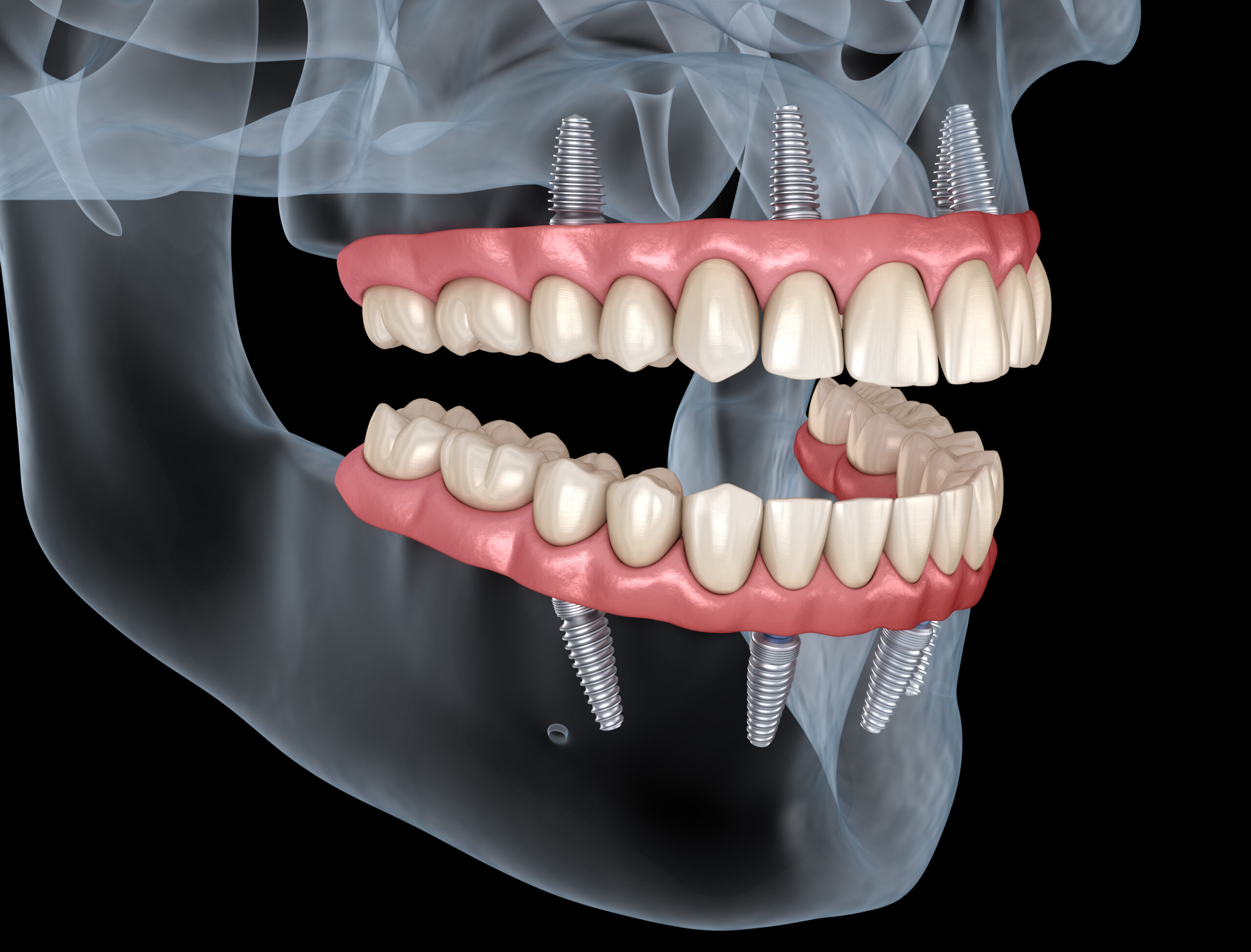

Secure fixation of the prosthesis, Natural appearance

Full restoration of chewing function, Preservation of bone tissue

Long-lasting results, Maximum comfort
What is implantation in the complete absence of teeth?
Implantation in cases of complete tooth loss is a modern method of restoring the dentition using titanium dental implants inserted into the jawbone to support a prosthesis. Unlike removable dentures, this technique ensures firm fixation and the sensation of natural teeth.
The installed implants restore not only the aesthetic aspect of the smile but also fully functional chewing, allowing the patient to eat, speak, and smile without discomfort. It is one of the most effective and durable dental restoration methods available today.

Price: Implantation in case of complete absence of teeth (edentia)
All price-
General consultation + treatment plan
250 PLN -
Tomography of 1 jaw
250 PLN -
Tomography of 2 jaws
350 PLN
Dental implant placement
-
JDental (Italy)
2 500 PLN -
Megagen (South Korea)
4 000 PLN -
Straumann (Switzerland)
5000 PLN -
Non-removable temporary denture on implants
6 000 PLN -
Non-removable permanent denture on implants
20 000 PLN
Do you want to treat your teeth while you sleep?
Schedule an appointment!
By clicking the button, you give your agreet your personal data in accordance with privacy policy.
Frequently asked questions about implants for total tooth loss
-
How many implants are needed to restore a full jaw?
Restoring the upper or lower jaw typically requires between 2 to 6 implants, depending on the chosen technique — such as All-on-2, All-on-4, or All-on-6.
-
How long does the implantation process take for full edentulism?
The timeline ranges from one day (for immediate-load, single-stage procedures) to several months when using the classic two-stage method with full osseointegration.
-
Is implantation possible with insufficient bone volume?
Yes, in most cases, implantation can be performed even with bone loss. This may involve bone grafting or using special implant systems designed for low bone density.
-
How long do implants last for full edentulism?
With proper care and regular dental check-ups, full-mouth implants can last 15-20 years or longer, and in many cases, practically a lifetime.
Implantologists who perform treatment for edentulism
View all doctors
Borys Minakov
Prosthodontist
His approach focuses on individually tailored treatment plans that not only solve current issues but also prevent future ones. This helps patients ...

Dmytro Ostrovskyi
Prosthodontist
Over 30 hands-on courses completed in 9 years of practice. A comprehensive approach guarantees stable, durable, and predictable results.

Kostiantyn Danyliuk
Oral Surgeon, Implantologist
Konstantin is a skilled specialist who combines in-depth knowledge and cutting-edge technology to achieve the best results. He maintains active com...
Reviews of full-arch dental implants in Krakow
Expert articles on the topic
View all blog-
26.02.2026
23
11 min. read
What is Dental Implant Procedure — A Complete Guide
Losing a tooth isn't always just about aesthetics. It's about self-confidence, the ability to smile without tension, the ability to…
Read more -
30.10.2025
169
7 min. read
How long does a dental implant last?
If you are reading this article, most likely you have already made an important decision: to replace a lost tooth with an implant. But somewhere inside there is still a doubt: “What’s next? Will I have to redo everything in a year or two?“ These are absolutely normal questions. Because when you choose implantation, you […]
Read more



Full dental implantation is a reliable and long-lasting solution that restores the functionality and appearance of the dentition, giving the patient back their comfort and confidence. At Dynasty Stomatology clinic in Poland, we offer advanced implantation options for patients with complete tooth loss. Book a consultation to find out which treatment plan suits your needs best.
What causes total tooth loss?
Complete tooth loss (total edentulism) can occur due to various reasons—age-related, health-related, or lifestyle factors. The most common causes include:
- Chronic periodontitis and other gum diseases that lead to tooth loosening;
- Advanced-stage dental caries;
- Jaw and facial injuries;
- Age-related changes and natural tooth loss;
- Genetic predisposition;
- Poor or delayed dental treatment;
- Systemic health issues (e.g., diabetes, osteoporosis);
- Poor oral hygiene and bad habits (e.g., smoking).
What Implantation Methods Are Used in Cases of Complete Absence of Teeth?
All-on-2 Implantation
This technique involves the placement of two implants to support a conditionally removable prosthesis. It is typically considered a temporary or budget-friendly solution for patients with significant bone atrophy or other limitations.
Advantages of All-on-2:
- Minimally invasive surgical procedure;
- Quick restoration of function and aesthetics;
- More accessible price point;
- Suitable for patients with limited bone tissue volume.
Disadvantages:
- Less stability compared to methods with more implants;
- Uneven load distribution on the jaw;
- Potential need to replace the structure over time;
- Limited indications for long-term use.
All-on-4 Implantation
The All-on-4 concept is one of the most popular options in modern dentistry for treating patients with a lack of teeth. Four implants are placed—two straight in the front and two angled in the back—to fix a non-removable full arch prosthesis.
Advantages of All-on-4:
- Provides stable support for the prosthetic arch;
- Requires fewer implants and less invasive implant placement;
- Faster recovery and restoration of chewing function;
- Often eliminates the need for bone augmentation.
Disadvantages:
- Not all patients qualify—adequate bone structure is required;
- Failure of one implant may compromise the whole dental structure;
- Higher cost compared to All-on-2.
All-on-6 Implantation
The All-on-6 technique uses six implants placed in the upper or lower jaw, offering maximum stability and longevity for the prosthesis. It is ideal for patients with sufficient bone volume and those needing increased chewing functionality.
Advantages:
- Enhanced strength and long-term stability;
- Even load distribution across the jaw;
- Enables the placement of a full arch prosthesis;
- Offers high aesthetic quality and comfort.
Disadvantages:
- Higher cost;
- Requires good bone condition or preliminary bone grafting in complex cases;
- More extensive surgical intervention.
The choice of implantation method in cases of total tooth loss should be discussed with the patient after a full diagnostic assessment, including x-rays or tomography. At Dynasty Stomatology dental clinic, our implantologists and specialists will help select the most suitable treatment plan based on the patient’s needs, clinical situation, and budget. Thanks to modern technology, even toothless patients can restore their smile in just one visit with precision and confidence.
Types of Implantation for Complete Edentulism
When treating complete tooth loss, dental implantation can be performed using two main approaches, depending on the clinical situation, the condition of the bone, and the selected method:
- Single-Stage Implantation (Immediate Load). This approach involves the placement of implants with temporary prosthetics fixed within 1-3 days after surgery. It allows for the immediate restoration of aesthetics and speech. A permanent crown or full arch prosthesis is placed after full osseointegration, typically within 3-6 months. This method is often used with All-on-4 or All-on-6, and in some cases with All-on-2.
- Two-Stage Implantation. In this more traditional surgical approach, the implantologist first places the implants and allows them to heal and integrate with the bone over 3-6 months. Only after successful osteointegration is the permanent prosthesis attached. This technique is recommended in complex cases, such as severe bone loss, chronic diseases, or after procedures like extraction and sinus lift. It offers a predictable outcome and is often chosen when precise clinical control is required.
In modern dentistry, immediate load protocols are increasingly popular, enabling patients to regain their smile almost instantly — even within one visit — while ensuring long-term success.
Benefits of Implantation for Complete Edentulism
Implantation is a modern, functional solution for patients with missing teeth. Unlike traditional removable dentures, implant-based systems offer a higher quality of life, stability, and comfort for many years.
Key advantages:
- Secure fixation of the prosthesis — the structure remains stable during speech and eating, eliminating embarrassment;
- Full restoration of chewing function — enjoy your favorite foods without restriction;
- Natural appearance — prosthetics are comparable to real teeth in both look and feel;
- Preservation of bone tissue — implants stimulate the jawbone, preventing atrophy;
- Long-lasting results — with proper care, implant systems can last 15–20 years, significantly longer than partial bridges, which typically serve 5–10 years;
- Maximum comfort — no irritation, rubbing, or need to remove the structure daily.
Implantation performed by an experienced dentist or implantologist with extensive experience, possibly using treatment under a microscope, ensures a precisely tailored solution to restore confidence, speech, and a full, active life.
If you’re considering dental implantation, we recommend scheduling a consult to determine whether you qualify and to plan your personalized treatment based on your needs and anatomy.
How Full-Mouth Dental Implantation Is Performed: Step-by-Step
Implantation in cases of complete edentulism is carried out in carefully planned stages to ensure precision, comfort, and long-lasting results. While the sequence may vary slightly depending on whether a single-stage or two-stage method is chosen, the principle of the procedure generally follows this structure:
- Consultation and Diagnostics. A dentist performs a thorough examination of the oral cavity and soft tissues. A CT scan is then taken to evaluate the jawbone volume and select the optimal implantation method. Using digital planning tools, the exact placement of implants and future non-removable prosthetics is mapped out.
- Preparation (if needed). This stage may include professional oral hygiene, treatment of inflammation, and extraction of remaining teeth. If there is bone deficiency, bone grafting or sinus lift may be performed to create a solid foundation for future implants.
- Implant Placement. Titanium implants are surgically placed into the jawbone under local anesthesia. Depending on the selected protocol, the dentist will insert 4 or 6 implants per arch — sometimes even two additional implants are used for better stability in certain cases.
- Placement of Temporary Prosthesis (for Immediate Load Protocols). With a single-stage approach, a temporary fixed prosthesis is installed practically on the same day or within a few days, allowing the patient to leave the clinic with a functional and aesthetic smile.
- Osseointegration. Over 3-6 months, the implants naturally integrate with the bone. During this time, it’s crucial to follow all recommendations and attend follow-up appointments to monitor healing progress.
- Permanent Prosthetics. Once healing is complete, a customized permanent bridge is fabricated and securely attached to the implants. This final structure fully restores both the appearance and function of the teeth.
The permanent prosthesis is firmly fixed and can only be removed by a dentist.
Contraindications for Full-Mouth Implantation
Despite the advantages of modern techniques, certain conditions may make implantation temporarily or permanently inadvisable:
- Uncontrolled diabetes;
- Active cancer;
- Severe cardiovascular disease;
- Immunodeficiency;
- Advanced osteoporosis;
- Blood clotting disorders;
- Exacerbation of chronic diseases;
- Alcohol or drug addiction;
- Mental health disorders;
- Pregnancy and breastfeeding;
- Insufficient bone volume (when augmentation is not feasible);
- Poor oral hygiene or active periodontitis.
Before any treatment, our clinic evaluates all potential risks individually to ensure the highest level of safety and the success of your procedure.
Durability and Care for Full-Mouth Dental Implants
Implants used in cases of total tooth loss are a reliable, long-lasting solution. With proper placement and adherence to dental care guidelines, they can last 15–20 years or even a lifetime. Longevity depends on the quality of materials, bone condition, oral hygiene, and regular dental check-ups.
Key Care Recommendations After Implantation:
- Brush daily with a soft-bristled toothbrush and non-abrasive toothpaste to protect the surface of the prosthesis.
- Use floss or super floss to clean between implants and under the prosthesis where brushes can’t reach.
- Clean your tongue and gums regularly to reduce plaque and bacterial buildup.
- Visit your dentist 1-2 times a year for professional cleanings and check-ups to monitor implant stability and soft tissue health.
- Use an oral irrigator to flush out debris from hard-to-reach areas.
- Avoid excessive pressure on the prosthesis by limiting very hard or sticky foods.
Following these simple steps will help extend the life of your implants and maintain their function and appearance for many years.
Cost of Full-Mouth Dental Implantation
The cost of dental implantation for full upper and lower jaw restoration at Dynasty Stomatology depends on the selected method, number of implants, and the need for any additional procedures. We offer competitive pricing, flexible payment options, and uphold a high standard of quality and safety. Schedule a consultation to receive an accurate cost estimate and personalized treatment plan.
Why Choose Dynasty Stomatology?
Implantation requires expertise and a comprehensive approach. At Dynasty Stomatology, we provide professional care with a focus on long-term results and patient comfort.
Clinic Advantages:
- Skilled implantologists with extensive experience;
- State-of-the-art equipment and modern technologies;
- Safe, effective surgical techniques;
- Personalized treatment protocols tailored to each patient;
- Convenient location and comfortable environment.
Full edentulism is not a sentence. If you’re facing total tooth loss, book a consultation with our dentist and take the first step toward restoring your smile.